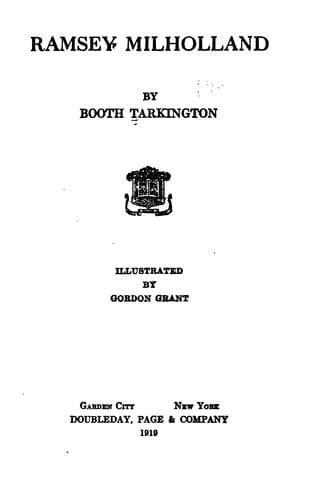
American fiction -- 20th century; Bildungsromans; World War, 1914-1918 -- United States -- Fiction; Young men -- Fiction
“Well, I could _stand_ 'em,” Ramsey said, more generously, “if they'd
ever give anybody a little to think about. What's the use always
draggin' in George Warshington and the Ole Flag? And who wants to
hear any more ole truck about 'from ole rocky New England to golden
California,' and how big and fine the United States is and how it's the
land of the Free and all that? Why don't they ever say anything new?
That's what I'd like to know.”
Milla laughed, and when he asked why, she told him she'd never heard
him talk so much “at one stretch.” “I guess that speech got you kind of
wound up,” she said. “Let's talk about something different.”
“I just soon,” he agreed. And so they walked on in silence, which
seemed to suit Milla. She hung weightily upon his arm, and they dawdled,
drifting from one side of the pavement to the other as they slowly
advanced. Albert and Sadie, ahead of them, called “good-night” from a
corner, before turning down the side street where Sadie lived; and then,
presently, Ramsey and Milla were at the latter's gate. He went in with
her, halting at the front steps.
“Well, g'night, Milla,” he said. “Want to go out walking to-morrow
night? Albert and Sadie are.”
“I can't to-morrow night,” she told him with obvious regret. “Isn't it
the worst luck! I got an aunt comin' to visit from Chicago, and she's
crazy about playing 'Five Hundred,' and Mama and Papa said I haf to stay
in to make four to play it. She's liable to be here three or four days,
and I guess I got to be around home pretty much all the time she's here.
It's the worst luck!”
He was doleful, but ventured to be literary. “Well, what can't be helped
must be endured. I'll come around when she's gone.”
He moved as if to depart, but she still retained his arm and did not
prepare to relinquish it.
“Well--” he said.
“Well what, Ramsey?”
“Well--g'night.”
She glanced up at the dark front of the house. “I guess the family's
gone to bed,” she said, absently.
“I s'pose so.”
“Well, good-night, Ramsey.” She said this but still did not release his
arm, and suddenly, in a fluster, he felt that the time he dreaded had
come. Somehow, without knowing where, except that it was somewhere upon
what seemed to be a blurred face too full of obstructing features, he
kissed her.
She turned instantly away in the darkness, her hands over her cheeks;
and in a panic Ramsey wondered if he hadn't made a dreadful mistake.
“S'cuse me!” he said, stumbling toward the gate. “Well, I guess I got to
be gettin' along back home.”
Chapter IX
He woke in the morning to a great self-loathing: he had kissed a girl.
Mingled with the loathing was a curious pride in the very fact that
caused the loathing, but the pride did not last long. He came downstairs
morbid to breakfast, and continued this mood afterward. At noon Albert
Paxton brought him a note which Milla had asked Sadie to ask Albert to
give him.
Public-domain text, read in full here on John Shaqi.
Reviews
Reviews
No reviews yet
Be the first to share your thoughts on this work.
Join the Discussion
Join the discussion
Sign in to leave a comment or review.
Sign InorCreate an account