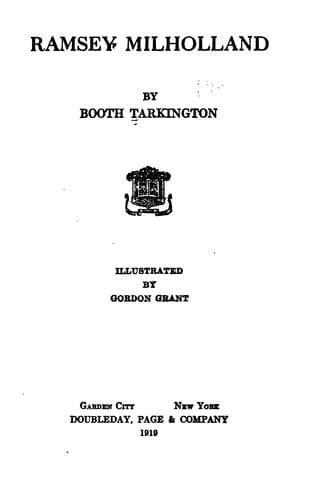
American fiction -- 20th century; Bildungsromans; World War, 1914-1918 -- United States -- Fiction; Young men -- Fiction
He came to the longest of all his pauses here, and the awful gravity of
the audience almost suffocated him. “Well,” he concluded, “it don't look
right to me.”
“Four minutes!” the chairman announced, for Ramsey's pauses had worn
away a great deal more of this terrible interval than had his eloquence.
“Opening statement for the negative: Miss D. Yocum. Four minutes.”
As Dora began to speak, Ramsey experienced a little relief, but only
a little--about the same amount of relief as that felt by a bridegroom
when it is the bride's turn to “respond,” not really relief at all, but
merely the slight relaxation of a continuing strain. The audience now
looked at Ramsey no more than people look at a bridegroom, but he failed
to perceive any substantial mitigation of his frightful conspicuousness.
He had not the remotest idea of what he had said in setting forth his
case for Germany, and he knew that it was his duty to listen closely
to Dora, in order to be able to refute her argument when his two-minute
closing speech fell due but he was conscious of little more than his own
condition. His legs had now gone wild beyond all devilry, and he had
to keep shifting his weight from one to the other in order even to hope
that their frenzy might escape general attention.
He realized that Dora was speaking rapidly and confidently, and that
somewhere in his ill-assembled parts lurked a familiar bit of him that
objected to her even more than usual; but she had used half of her time,
at least, before he was able to gather any coherent meaning from what
she was saying. Even then he caught only a fragment, here and there,
and for the rest--so far as Ramsey was concerned--she might as well have
been reciting the Swedish alphabet.
In spite of the rather startling feebleness of her opponent's statement,
Dora went at her task as earnestly as if it were to confute some monster
of casuistry. “Thus, having demonstrated that _all_ war is wrong,” she
said, approaching her conclusion, “it is scarcely necessary to point out
that whatever the actual circumstances of the invasion, and whatever the
status of the case in international law, or by reason of treaty, or the
German oath to respect the neutrality of Belgium, which of course was
grossly and dishonorably violated--all this, I say, ladies and gentlemen
of the Lumen Society, all this is beside the point of morals. Since, as
I have shown, _all_ war is wrong, the case may be simplified as follows:
All war is morally wrong. _Quod erat demonstrandum_. Germany invaded
Belgium. Invasion is war. Germany, therefore, did moral wrong. Upon
the legal side, as I began by pointing out, Germany confessed in the
Reichstag the violation of law. Therefore, Germany was justified in the
invasion neither morally nor legally; but was both morally and legally
wrong and evil. Ladies and gentlemen of the Lumen Society, I await the
refutation of my opponent!”
Public-domain text, read in full here on John Shaqi.
Reviews
Reviews
No reviews yet
Be the first to share your thoughts on this work.
Join the Discussion
Join the discussion
Sign in to leave a comment or review.
Sign InorCreate an account