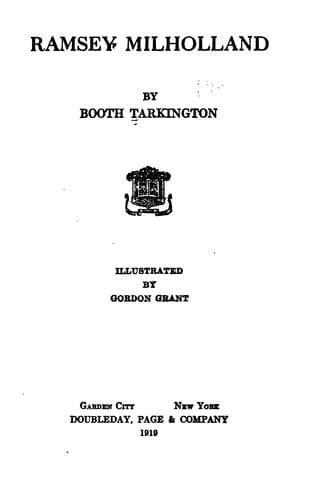
American fiction -- 20th century; Bildungsromans; World War, 1914-1918 -- United States -- Fiction; Young men -- Fiction
That early spring of 1915 the two boys and their friends and Brethren
talked more of the war than they had in the autumn, though the subject
was not an all at absorbing one; for the trenches in Flanders and France
were still of the immense, remote distance. By no stretch of imagination
could these wet trenches be thought greatly to concern the “frat,” the
Lumen, or the university. Really important matters were the doings of
the “Track Team,” now training in the “Gym” and on the 'Varsity Field,
and, more vital still, the prospects of the Nine. But in May there came
a shock which changed things for a time.
The _Lusitania_ brought to every American a revelation of what had lain
so deep in his own heart that often he had not realized it was there.
When the Germans hid in the sea and sent down the great merchant ship,
with American babies and their mothers, and gallantly dying American
gentlemen, there came a change even to girls and boys and professors,
until then so preoccupied with their own little aloof world thousands of
miles from the murder.
Fred Mitchell, ever volatile and generous, was one of those who went
quite wild. No orator, he nevertheless made a frantic speech at the
week's “frat meetings,” cursing the Germans in the simple old English
words that their performance had demonstrated to be applicable, and
going on to demand that the fraternity prepare for its own share in the
action of the country. “I don't care _how_ insignificant we few fellows
here to-night may seem,” he cried; “we can do our little, and if
everybody in this country's ready to do their own little, why, that'll
be plenty! Brothers, don't you realize that all _over_ the United States
to-night the people are feeling just the way we are here? Millions and
millions and millions of them! Wherever there's an American he's _with_
us--and you bet your bottom dollar there are just a few more Americans
in this country of ours than there are big-mouthed lobsters like that
fellow Linski! I tell you, if Congress only gives the word, there could
be an army of five million men in this country to-morrow, and those
dirty baby-killin' dachshunds would hear a word or two from your Uncle
Samuel! Brothers, I demand that something be done right here and now,
and by us! I move we telegraph the Secretary of War to-night and offer
him a regiment from this university to go over and help _hang_ their
damn Kaiser.”
The motion was hotly seconded and instantly carried. Then followed
a much flustered discussion of the form and phrasing of the proposed
telegram, but, after everything seemed to have been settled, someone
ascertained by telephone that the telegraph company would not accept
messages containing words customarily defined as profane; so the
telegram had to be rewritten. This led to further amendment, and it was
finally decided to address the senators from that state, instead of the
Secretary of War, and thus in a somewhat modified form the message was
finally despatched.
Public-domain text, read in full here on John Shaqi.
Reviews
Reviews
No reviews yet
Be the first to share your thoughts on this work.
Join the Discussion
Join the discussion
Sign in to leave a comment or review.
Sign InorCreate an account