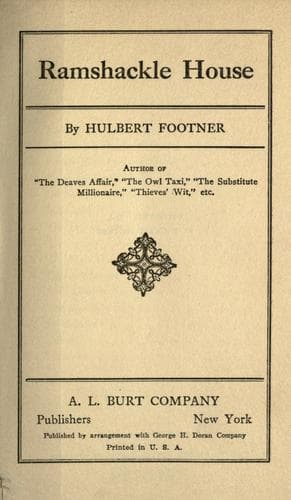
Canadian fiction -- 20th century; Detective and mystery stories
On a certain stifling morning in mid-summer, amongst the dozens of
court-rooms the interest of the building was focused in General
Sessions, Part One, where the case of the People versus Counsell was
being tried under Stockman, J. A murder trial. Common as they are in
that building a murder trial never quite loses its zest, and this,
owing to the prominence of the persons concerned, was a celebrated
case. Every morning a great crowd struggled to get into the courtroom,
though the evidence was not of a sensational nature. There was no
woman in the case. It was a foregone conclusion too; one of those
cases which had been tried out in the newspapers before being brought
into court, and a verdict of guilty rendered. Nobody had a good word
for the defendant except the morbid women who stormed the court-room
doors, and who secured a majority of the seats inside, simply because
they were more persistent than the men. These women always sympathize
with the prisoner, particularly if, as in this case, he happens to be
young and comely.
As a result of the furore in the newspapers many days had been taken up
in the effort to secure an impartial jury. But once the taking of
evidence began the proceedings moved swiftly enough. Only two days had
been required by the prosecutor to present his case. Hackett, the
particular star of the district-attorney's office, handled it. He had
scarcely been obliged to exert himself; everything was going his way.
In three days more the defendant's direct testimony was all in.
Counsell was his own principal witness. He had told a straightforward
story on the stand, and a ruthless cross-examination had failed to
shake it. Unfortunately for him he had no witnesses to support his
story. Proof of it rested with the dead man. There had been no
witnesses to the final scene between them. The trial had now reached
the stage of rebuttal testimony offered by the People.
When Court adjourned for the noon recess, Corveth of Defendant's
counsel made his way out of the building with a heavy air of dejection.
He was a young man, the same age as the prisoner, an old friend it was
said, and he had full charge of Counsell's case. He had put up a
strenuous fight for his friend, but not perhaps a brilliant one. He
was a first-rate lawyer, but he lacked the art of certain famous
pleaders who, when they have a bad case, set out to charm and dazzle
judge and jury with moving if irrelevant eloquence. Corveth was in
deadly earnest. He passionately believed in his client's innocence,
but he had scarcely succeeded in proving it. And he had often
irritated the Bench by his dogged fight on points of law which took up
time without apparently getting anywhere. Even now it was a mistake of
tactics for Corveth so clearly to betray his discouragement to the
inquisitive observers in the galleries.
Public-domain text, read in full here on John Shaqi.
Reviews
Reviews
No reviews yet
Be the first to share your thoughts on this work.
Elsewhere in the archive
Join the Discussion
Join the discussion
Sign in to leave a comment or review.
Sign InorCreate an account