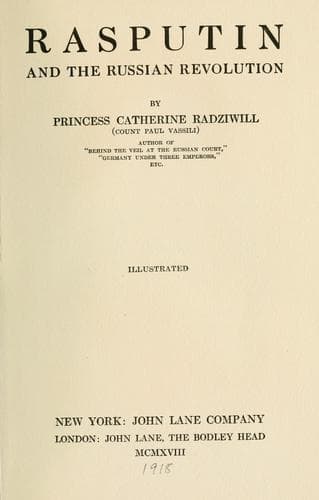
Rasputin and the Russian RevolutionRadziwill, Catherine, Princess
History
Rasputin and the Russian Revolution
Radziwill, Catherine, Princess
Rasputin, Grigorii Efimovich, 1869-1916; Soviet Union -- History -- Revolution, 1917-1921
But after all was he really liberal, this Czar who had so little
known or understood how to endear himself to his subjects, or did he
merely say that such was the case, in order to dissimulate despotic
leanings which were the more dangerous that they exercised themselves
without any judgment or without any justification for their explosion?
A considerable number of persons have wondered about it, and have
found themselves unable to solve this riddle. To hear him speak,
one would have thought that such was the case, whilst it was hardly
possible to talk with him for any length of time, without finding him
a sympathetic, kind personality, curious mixture of totally different
elements in a character that was chiefly remarkable for its weakness.
One could like him, one could even admire some of the qualities which
he undoubtedly possessed, but it was utterly impossible to respect
in him the Monarch, or to esteem the man, so strange did his conduct
sometimes appear, a conduct which finally dragged him into an abyss,
together with his family and with his dynasty. Physically, he had a sad
and kind face, affectionate and clear blue eyes, a charming voice, much
affability in his manners; a wonderfully bright smile, reminding one of
his mother’s, a most cordial manner of shaking hands that went straight
to the heart and made one suspect a lot of things which in reality did
not exist; a rapid and quick walk, a certain hesitation in his speech,
and in the expression of his face at times; such was the man. Morally,
he was possessed of honesty of purpose to such an extent that he could
realise its absence in others; he had no will of any kind, but a good
deal of obstinacy; principles which were always forgotten when they
interposed themselves between his personal welfare and his duty; no
sense of responsibility, but a very exalted opinion of his own rights,
and especially of his might; the conviction that autocracy ought to be
maintained at any cost, and simultaneously the sincere desire, during
a short while, to govern according to the change of system to which
he had been compelled to submit, more by the force of things and of
events, than through his personal opinions; absolutely no consciousness
of the great events with which he found himself mixed up, or of the
wants of the country over which he ruled; no conception of the aims
he ought to have had in view; no real sympathy for his people, but a
vague wish to help them; an unacknowledged dread of finding himself
thrown into any intimate contact with the mob, combined with the hope
that this feeling would not be noticed by the public at large; far too
much confidence in incapable advisers; an exaggerated mistrust of the
persons courageous enough to tell him the truth, an absolute incapacity
to resist bad influences; sometimes considerable dignity, and often
useless haughtiness; a good deal of superstition combined with
religion; a deep conviction that his own person was something so sacred
Public-domain text, read in full here on John Shaqi.
Reviews
Reviews
No reviews yet
Be the first to share your thoughts on this work.
Elsewhere in the archive
Join the Discussion
Join the discussion
Sign in to leave a comment or review.
Sign InorCreate an account