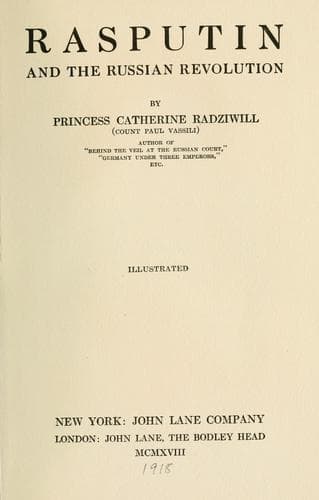
Rasputin and the Russian RevolutionRadziwill, Catherine, Princess
History
Rasputin and the Russian Revolution
Radziwill, Catherine, Princess
Rasputin, Grigorii Efimovich, 1869-1916; Soviet Union -- History -- Revolution, 1917-1921
that though it might come to be attacked and criticised, yet nobody
would be daring enough to lay a sacrilegious hand upon it; a complete
incapability of making any distinction between his friends and his
foes, and such a persuasive manner that no one could ever contradict
or resist him, so that the Revolution in which he lost his Crown must
have surprised him to the extent of paralysing all his faculties of
realising its importance and its extent; such was the Sovereign.
CHAPTER II
By the side of this Monarch in whom his subjects at last lost every
vestige of confidence, there stood a sinister figure, the bad genius
of a reign that would most probably have been far more peaceful if
it had not been there: the figure of his wife, the Empress Alexandra
Feodorovna, “the German,” as she had been called even long before the
present war broke out. It was undoubtedly to her that were due, at
least to a considerable extent, the various misfortunes which have
assailed the unfortunate Nicholas II., and it was also she, who, in the
brief space of a few short years, discredited him together with the
throne to which he had raised her. It was she who destroyed all the
prestige which the Monarchy had retained in Russia, until the day when
she tarnished it. She was another Marie Antoinette, without any of the
qualities, or the courage that had distinguished the latter, who had
become the object of the hatred and furious dislike of her subjects,
more on account of the vices which were attributed to her, than of
those which she really possessed. In regard to the Consort of the Czar
Nicholas II., it was just the contrary that occurred, because the
general public never became aware of all the strange details concerning
the private life of this Princess, who compromised by her conduct the
inheritance of her son, together with the Crown which she herself
wore. On her arrival in Russia she had been met with expressions of
great sympathy, and it would have been relatively easy for her to
make herself liked everywhere and by everybody, because the peculiar
circumstances which had accompanied her marriage had won for her a
sincere popularity all over Russia. At the time she arrived there as
the bride of the future Sovereign there existed in the country a strong
current of anglomania, which disappeared later on, to revive again
during the last year or two. The Princess who came to Livadia from
Darmstadt was the granddaughter of Queen Victoria of Great Britain, by
whom she had been partly brought up, a fact which spoke in her favour
because it was supposed that her education would have developed in her
liberal opinions, love for freedom, and the desire to make herself
liked as well as respected by her future subjects, who received her
with the more enthusiasm that they all hoped she would influence in the
right direction her husband, whose weakness of character was already
at that time known by those who had had the opportunity of becoming
acquainted with him.
Public-domain text, read in full here on John Shaqi.
Reviews
Reviews
No reviews yet
Be the first to share your thoughts on this work.
Elsewhere in the archive
Join the Discussion
Join the discussion
Sign in to leave a comment or review.
Sign InorCreate an account