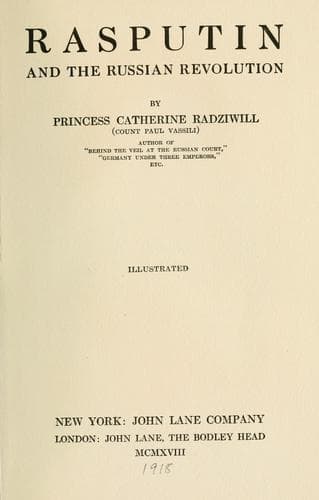
Rasputin and the Russian RevolutionRadziwill, Catherine, Princess
History
Rasputin and the Russian Revolution
Radziwill, Catherine, Princess
Rasputin, Grigorii Efimovich, 1869-1916; Soviet Union -- History -- Revolution, 1917-1921
I must give the latter their due, they did not keep these illusions
for any length of time, because from the very beginning of her
married life the new Czarina contrived to wound the feelings and the
susceptibilities of all those with whom she was thrown into contact.
She had absolutely no tact, and she fancied that if she allowed herself
to be amiable in regard to any one, she would do something which was
below her dignity. She applied herself to treat everybody from the
height of her unassailable position, and she took good care never to
say one word that might be interpreted in the light of a kindness or
amiability towards the people who were being presented to her, so that
though they tried hard to attribute her utter want of politeness to
a timidity which in reality did not exist, yet they felt offended at
it. Russian society had been used to something vastly different, and
to a certain familiarity in its relations with its Sovereigns. The
mother of Nicholas II., the Empress Marie, had been worshipped for the
incomparable charm of her manners, and the simple kindness with which
she received all those who were introduced to her, asking them to sit
down beside her, and talking with them in a charming chatty way,
full of sweet and unassuming dignity. Her daughter-in-law abolished
these morning receptions which had brought the Sovereign into close
intercourse with so many different people. She received the ladies who
had asked to be presented to her, standing, surrounded by her court,
with two pages behind her holding her train, and she merely stretched
out her hand to be kissed by those whom she condescended to admit
into her august presence, without speaking one single word to them.
Of course the people whom she treated with such rudeness felt hurt
at it, and it began to be said among the public that the Empress was
not at all amiable, and people abstained from seeking her presence
or appearing at Court, unless it was absolutely necessary to do so,
leaving thus the field free to people devoid of self respect, to whom
one impoliteness more or less did not matter. The balls at the Winter
Palace, which formerly had been such brilliant ones, became dull and
monotonous. The smile of the Empress Marie was no longer there to
enliven them. At last the Czarina left off giving any, and no one
missed them, or felt the worse for their absence. One felt rather
relieved than otherwise not to be compelled any longer to appear in the
presence of the Empress.
Public-domain text, read in full here on John Shaqi.
Reviews
Reviews
No reviews yet
Be the first to share your thoughts on this work.
Elsewhere in the archive
Join the Discussion
Join the discussion
Sign in to leave a comment or review.
Sign InorCreate an account