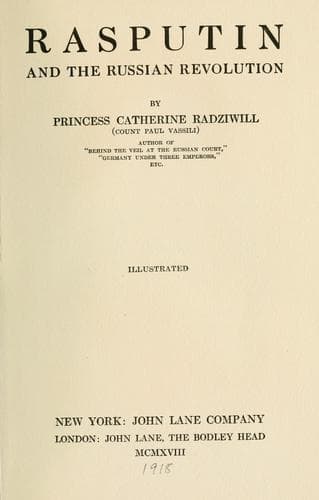
Rasputin and the Russian RevolutionRadziwill, Catherine, Princess
History
Rasputin and the Russian Revolution
Radziwill, Catherine, Princess
Rasputin, Grigorii Efimovich, 1869-1916; Soviet Union -- History -- Revolution, 1917-1921
As time went on, an abyss was formed which divided the Consort of
Nicholas II. from her subjects, whose feelings manifested themselves
quite openly on the day of the solemn entry of the Imperial Family into
Moscow, on the eve of the Coronation of the new Sovereigns. The golden
carriage that contained the Dowager Empress was followed all along its
way by the cheers of the population of the ancient capital, whilst a
tragic silence prevailed during the passage of the coach in which sat
her daughter-in-law. The contrast was such a striking one that it was
everywhere noticed and commented upon.
This latent animosity, the first signs of which manifested themselves
on this memorable occasion, became even more acute after the
catastrophe of Khodinka. Russia did not forgive its Empress for having
danced the whole of the night that had followed upon it, and for
having given no sign of regret at a disaster that had cost the life
of more than twenty thousand people, who had perished in the most
awful manner possible. The divorce between her and her subjects was
accomplished definitely after that day, and without any hope of a
future reconciliation coming to annul its effects.
This unpopularity, and let us say the word, this hatred of which she
became the object, did not remain unknown to the Empress, who either
noticed it herself, or else was enlightened on the point by her
German relatives, with whom she had remained upon most intimate and
affectionate terms. She attributed it at first to the fact that she had
not during many years given a son to her husband and an heir to the
Russian Throne, but later on she was compelled to acknowledge that the
dislike which she inspired was due to other causes which were dependant
on her own self. The discovery angered and soured her, and made her
nasty and ill natured. She tried to avenge herself by the assumption
of an authority in the exercise of which she found a certain pleasure,
because it procured her at least the illusion of an absolute power,
allowing her, if the wish for it happened to cross her mind, to crush
all those who were bold enough to criticise any of her actions or her
general demeanour.
Public-domain text, read in full here on John Shaqi.
Reviews
Reviews
No reviews yet
Be the first to share your thoughts on this work.
Elsewhere in the archive
Join the Discussion
Join the discussion
Sign in to leave a comment or review.
Sign InorCreate an account