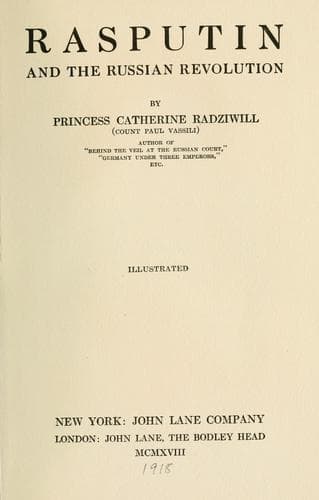
Rasputin and the Russian RevolutionRadziwill, Catherine, Princess
History
Rasputin and the Russian Revolution
Radziwill, Catherine, Princess
Rasputin, Grigorii Efimovich, 1869-1916; Soviet Union -- History -- Revolution, 1917-1921
Her character was obstinate without being firm. She believed herself
in all earnestness to be the equal of her husband, and did not think
of herself at all as his first subject, so that, instead of giving to
others the example of deference towards their Sovereign, she applied
herself to lower him down to her own level, to diminish his importance,
and to show quite openly that she did not in the very least respect
either him or the throne which he occupied. One heard a number of
anecdotes on the subject, among others one to the effect that during
a regimental feast, at which the Imperial Family was present, the
Empress, who had arrived a little in advance of the Czar, did not rise
from her seat when he entered the riding school in which the guests
were assembled to receive him. This want of deference was commented
upon in unfavourable terms, and caused such a scandal that Alexandra
Feodorovna was taken to task for it by her mother-in-law, with the only
result that she impertinently told the latter to mind her own business
and to hold her tongue. The Dowager Empress did not allow her to repeat
such a remark, and withdrew herself almost entirely from the Court,
much to the regret of all her admirers. All these things were perhaps
not important ones, at least from other points of view than the purely
social one, but they constituted this drop of water, which by its
constant and continual dripping ends in attacking the solidity of the
hardest granite. Very soon it became a subject of general knowledge
that no one cared for the Empress, and one came to the conclusion
that this initial want of sympathy would easily become very real and
implacable hatred.
The woman who had become the object of it, instead of trying to fight
against the general dislike which she inspired, did absolutely nothing
to try to persuade her subjects that she was not the detestable being
she had been represented to be, but that she cared for their welfare,
in spite of her cold appearance. The haughty and mistaken pride which
was one of the chief features in her strange character, led her to
retire within herself and to try to avoid seeing the people, who by
that time had grown to meet her whenever she appeared in public, with
angry and unpleasant expressions in their faces. The Imperial Court
under her rule was quickly transformed from the brilliant assemblage
it had been into a desert--a solitude no one cared to disturb. The
Empress amused herself chiefly in turning tables and in evoking spirits
from the other world, in company with mediums of a low kind who abused
the confidence that she so unwisely and unnecessarily placed in them,
and predicted for her (as it was to their interest to do) a happy and
prosperous future.
Public-domain text, read in full here on John Shaqi.
Reviews
Reviews
No reviews yet
Be the first to share your thoughts on this work.
Elsewhere in the archive
Join the Discussion
Join the discussion
Sign in to leave a comment or review.
Sign InorCreate an account