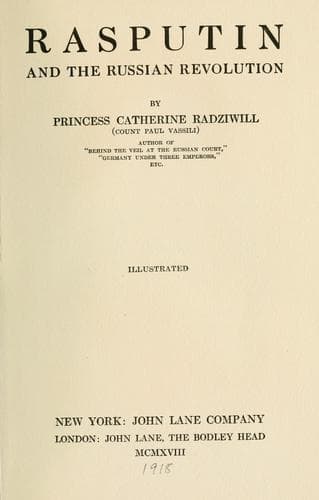
Rasputin and the Russian RevolutionRadziwill, Catherine, Princess
History
Rasputin and the Russian Revolution
Radziwill, Catherine, Princess
Rasputin, Grigorii Efimovich, 1869-1916; Soviet Union -- History -- Revolution, 1917-1921
It was about that time, that is just before the birth of the Heir to
the Throne, and whilst the war with Japan was being fought, that people
began to spread dark rumours concerning the private life of Alexandra
Feodorovna. A most extraordinary friendship which she contracted with
a lady whose reputation left very much to be desired, and who had been
divorced from her husband under circumstances that had given rise to
much talk, Madame Wyroubieva, was severely criticised. The Empress
remained deaf to all the hints which were conveyed to her on the
subject. She kept the lady in question beside her, gave her rooms in
the Imperial Palace, and took her about with her wherever she went,
without minding in the least the impression which this bravado of
public opinion produced everywhere. Another friendship for a certain
Colonel Orloff, an officer in her own regiment of lancers, also gave
rise to considerable gossip, which increased in intensity when after
the death of the latter, who committed suicide under rather mysterious
circumstances, the Empress repaired every afternoon to the churchyard
where he was buried, prayed and laid flowers upon his grave. One
wondered why she did such strange things, and of course persons were at
once found to explain her motives in a manner which was the reverse of
charitable.
The Emperor knew and saw all that was going on, but said nothing. His
wife by that time had acquired over his mind quite an extraordinary
influence, and either he did not dare to make any remarks as to the
originality which she displayed in her conduct, or else he imagined
that her position put her so much above criticism that it was useless
to interfere with what she might feel inclined to do in the matter of
eccentricity. A legend soon established itself in regard to Alexandra
Feodorovna. She was said to suffer from a nervous affection, which
obliged her at times to keep to her own apartments, and not to appear
in public. People tried, thanks to this pretext, to explain her absence
on different occasions when her position would have required her to
show herself to her subjects. But the truth of the matter was that
the Empress did not wish to see anybody, outside the small circle of
people before whom she need not constrain herself to be amiable or
pleasant; and that utterly forgetful of the duties entailed upon her
by her high rank and great position, she wanted only to live according
to her personal tastes, surrounded by flatterers or by people resigned
beforehand to accept and bow down before her numerous caprices, and to
fulfil with a blind obedience all the commands it might please her to
issue to them.
Public-domain text, read in full here on John Shaqi.
Reviews
Reviews
No reviews yet
Be the first to share your thoughts on this work.
Elsewhere in the archive
Join the Discussion
Join the discussion
Sign in to leave a comment or review.
Sign InorCreate an account