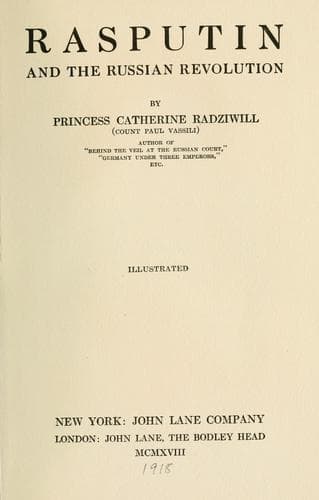
Rasputin and the Russian RevolutionRadziwill, Catherine, Princess
History
Rasputin and the Russian Revolution
Radziwill, Catherine, Princess
Rasputin, Grigorii Efimovich, 1869-1916; Soviet Union -- History -- Revolution, 1917-1921
She mixed openly in public affairs, and began to play a leading part
in the conduct of the State. Her husband never dared to refuse her
anything, and the Empress attempted to lead the destinies of Russia in
the sense which she had the most at heart, that is in one corresponding
to the interests of her own native country. She had remained entirely
German in her tastes and opinions, and her English education had
had absolutely no influence on her character. Thanks to an active
correspondence which she kept up with her brother, the Grand Duke of
Hesse, she was able to acquaint the Emperor William II. with a good
many things that he would never have learned without her. This is the
more curious, if one takes into account the fact that during the first
years which had followed upon her marriage, and especially after the
different journeys which she had made in France, Alexandra Feodorovna
had expressed great sympathy and admiration for everything that was
French, perhaps on account of the great enthusiasm with which she had
been received by the French population. But later on, thanks to the
influence of the unscrupulous people into whose hands she fell, her
ideas became transformed, and she boldly tried to fight against the
French leanings of her husband, and to lead him towards an alliance
with Germany, in which she thought that she saw the advantage, and even
the safety of her throne, and of the son she loved above everything
else in the world.
All these facts could not long remain unknown, and soon the public
began to discuss them, together with the story of the different
intrigues of which the Palace of Tsarskoie Selo became the centre.
Thanks to the friends whom she had chosen for herself, the ante-chamber
of the Empress was transformed into a kind of annex to the Stock
Exchange, where all sorts of people, honest or dishonest, used to meet,
in order to obtain through her intercession more or less extravagant,
if not dangerous, favours. Thanks to Madame Wyroubieva, there were
introduced into the intimacy of the Czarina certain members of the
orthodox clergy recommendable only by their love for money and for
lucrative employments, or rich dioceses and monasteries. The Empress
together with her sister, the Grand Duchess Elisabeth, who after the
murder of her husband had become a nun and the superior of a cloister
which she had founded in Moscow, and to whom one might have applied
with success the remark of Marie Antoinette in regard to her aunt
Madame Louise of France, “she is the most intriguing little Carmelite
in the whole of the kingdom,” tried to mix themselves up in every
important matter in the State, and to lead it according to their
own lights and aims, making use of the Emperor as of an instrument
of their own private ambitions and desires. They were both fierce
reactionaries, who from the first day that Nicholas II. had promulgated
the Constitution of the 17th of October, had tried to persuade him to
recall it.
Public-domain text, read in full here on John Shaqi.
Reviews
Reviews
No reviews yet
Be the first to share your thoughts on this work.
Elsewhere in the archive
Join the Discussion
Join the discussion
Sign in to leave a comment or review.
Sign InorCreate an account