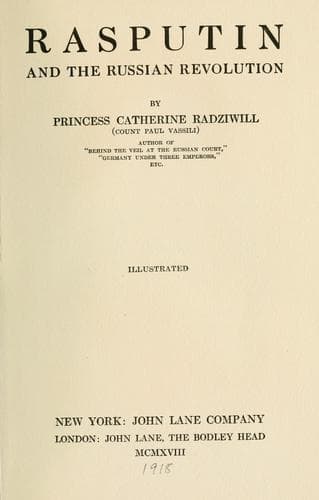
Rasputin and the Russian RevolutionRadziwill, Catherine, Princess
History
Rasputin and the Russian Revolution
Radziwill, Catherine, Princess
Rasputin, Grigorii Efimovich, 1869-1916; Soviet Union -- History -- Revolution, 1917-1921
The only brother of Nicholas II., the Grand Duke Michael
Alexandrovitsch, saw the influence of the Empress exercised against
him in a manner which was even more odious, because she contrived to
deprive him of the control not only of his fortune, but also of his
personal liberty to manage his estates. With her mother-in-law, the
Dowager Empress Marie, Alexandra Feodorovna showed herself absolutely
abominable in her disdain, haughtiness and pride. With the persons
composing her court and household, she was unpleasant and bitter. Even
in regard to her own daughters she proved herself heartless, and she
never once during the twenty-three years which followed her arrival
in Russia until the day of her downfall, tried to do any good around
her or induce her husband to accomplish one of those actions full of
generosity and mercy which unite a nation with its Sovereign, and make
their hearts beat together for some noble cause or other. Then again
there occurred the Rasputin incident. I have discussed it at length in
the first part of this book, and shall therefore not enter here into a
second description of the career of this strange personage, this low
Cagliostro of a reign that did not deserve to have any great nobleman
or even gentleman for its favourite. The only thing which I want to
point out to the reader, is the responsibility which devolves upon the
Empress in this disagreeable story, which more perhaps than anything
else hastened the fall of the old Romanoff monarchy. Whether she was
really persuaded of the holy character of the sinister adventurer who
had contrived so cleverly to exploit her credulity, or whether there
was in this curious infatuation for an unworthy object a question of
hypnotism, combined with the extravagance of a badly balanced mind
and imagination, it is difficult to say, especially when one has not
followed otherwise than by hearsay the different incidents of this
almost unbelievable tragedy. It is probable that the mystery, such as
it was, will never be quite explained, but one may reasonably suppose
that the perpetual invocations to spirits of another world, which
Alexandra Feodorovna had practised for so many years, have had a good
deal to do with the obstinacy with which she insisted upon imposing
this personage upon all those who surrounded her, and with which
she allowed him to interfere with the details of her family life, a
thing which went so far that one day the governess of the young Grand
Duchesses, Mademoiselle Toutscheff, a most distinguished lady, went to
seek the Emperor, and told him that she could no longer be responsible
for the education of his daughters if Rasputin was allowed to enter
their apartments at every hour of the day and night. The only reply
which was made by Nicholas II. to this communication was that the
Empress ought not to be crossed, on account of the state of her nerves.
He seemed to approve of everything that was going on in his house,
Public-domain text, read in full here on John Shaqi.
Reviews
Reviews
No reviews yet
Be the first to share your thoughts on this work.
Elsewhere in the archive
Join the Discussion
Join the discussion
Sign in to leave a comment or review.
Sign InorCreate an account