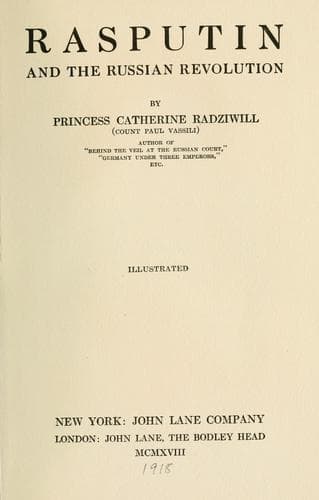
Rasputin and the Russian RevolutionRadziwill, Catherine, Princess
History
Rasputin and the Russian Revolution
Radziwill, Catherine, Princess
Rasputin, Grigorii Efimovich, 1869-1916; Soviet Union -- History -- Revolution, 1917-1921
It was thanks to the initiative of the Empress that the
first Duma was dissolved, and that the government began to exercise
considerable pressure over the elections in order to prevent the
candidates whom it believed it could not trust from being chosen by
their constituents. One Minister after another of those whom the
Czar appointed in rapid succession, resigned their functions, until
at last it was an acknowledged fact in Russia that no honest trial
of constitutional government could or would be attempted so long as
Alexandra Feodorovna would be there to counteract its existence. When
the Revolution broke out in the year 1905, and especially at the time
of the disturbances which took place in Moscow, it was the Empress
who excited her husband to adopt rigorous measures in order to crush
it, measures which led to nothing, and which only made Nicholas II.
a little more unpopular than he already was among his subjects. It
was related, whether true or not I cannot say, that when the famous
Semenovsky Regiment was sent to Moscow to reduce into submission the
insurrection which had broken out there, Alexandra Feodorovna had
desired to say good-bye to the officers before their departure, and
that the only recommendation which she had made to them had been not to
show any mercy to the insurgents. She had read without understanding it
in the very least, the history of the French Revolution in 1789, and
one had often heard her say that to show any weakness or compassion in
times of danger was equivalent to signing one’s own death warrant. Her
friends were nearly all of them men and women with a bad reputation,
and amidst the circle of her own immediate family she had only
contrived to make herself enemies. Thanks to her influence, and to her
petty personal spite, the young Grand Duke Cyril, the son of the Grand
Duke Vladimir, was deprived of his titles and dignities and exiled from
Russia for having dared to marry his first cousin, the divorced wife of
the Empress’s brother, the Grand Duke of Hesse, the Princess Victoria
Melita of Edinburgh. This punishment, however, was promptly cancelled,
thanks to the numerous protests which followed upon it from all
quarters, but the two people concerned never forgave the Empress her
attitude in regard to their union, and we saw an echo of this hostility
the other day when the Grand Duke Cyril on the outbreak of the
Revolution tried to play the part of Philippe Egalité in the Romanoff
family, and went with his regiment to put himself at the disposal of
the new government appointed by the Duma.
Public-domain text, read in full here on John Shaqi.
Reviews
Reviews
No reviews yet
Be the first to share your thoughts on this work.
Elsewhere in the archive
Join the Discussion
Join the discussion
Sign in to leave a comment or review.
Sign InorCreate an account