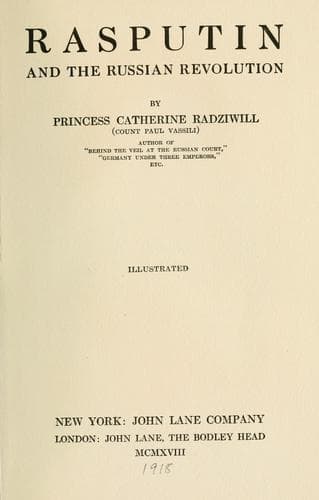
Rasputin and the Russian RevolutionRadziwill, Catherine, Princess
History
Rasputin and the Russian Revolution
Radziwill, Catherine, Princess
Rasputin, Grigorii Efimovich, 1869-1916; Soviet Union -- History -- Revolution, 1917-1921
And she, this woman who alone stands responsible for all this ruin that
has overtaken her consort, and his dynasty, did she ever understand
the terrible responsibility that she had assumed? Did she ever try
to be for her husband the faithful companion whom he required, and on
whom he might have leant in the hour of danger and of peril? Did she
attempt to develop in him those strong and virile qualities a sovereign
conscious of his might requires to be able to handle it wisely? Did
she ever enter into the needs of her people, or identify herself with
the interests of the nation whose Empress she happened to be? Alas!
Alas! history has already replied to those questions, and it is history
which tells us that, thanks to Alexandra Feodorovna, the inheritance
bequeathed by Peter the Great to his posterity has been squandered and
lost. If there has ever existed a woman who has proved fatal to all
those with whom her lot has been thrown, it is this little Hessian
Princess, whom fate or chance associated with one of the greatest
political crises of which Russian history will keep the record and the
remembrance, and for whose tears no one will find any pity, even when
her sorrows will need it most.
CHAPTER III
In one of her letters addressed to her daughter Marie Antoinette, the
Empress Marie Therese wrote: “I am glad to hear that you have decided
to re-establish the old etiquette and representation of Versailles.
However tiresome it may be, its inconveniences are still far less than
those which arise out of its absence. A Court must learn to know well
its sovereigns.” These words of a woman who knew better than any other
queen had ever known how to uphold the prestige of her crown, ought
to have been remembered by the Czar Nicholas II., because it is an
undoubted fact that the custom which was established during his reign
to keep the Emperor and his family isolated from the nation over which
he ruled, had a good deal to do with the change that established itself
gradually in the ideas of the people, as well as in the minds of the
aristocracy, in regard to the reigning house. One forgot that there
existed in Russia an Emperor, and one only remembered the manifold
abuses which were the consequence of the detestable government to
which the nation was subjected. All the personal ties that might have
bound the monarch with those who could in an emergency have defended
him against danger, had been snapped asunder by that monarch himself.
St. Petersburg, which formerly (I have now in mind only the upper
classes) had converged towards the sun represented by the Imperial
Palace and its inhabitants, learned how to do without it, and it was
no longer considered to be an honour to have relations, no matter of
what nature, with any member of the House of Romanoff. The Imperial
Family, in imitation of the conduct pursued by its Chief, seemed as
if it wished to efface itself and to lead the existence of common
Public-domain text, read in full here on John Shaqi.
Reviews
Reviews
No reviews yet
Be the first to share your thoughts on this work.
Elsewhere in the archive
Join the Discussion
Join the discussion
Sign in to leave a comment or review.
Sign InorCreate an account