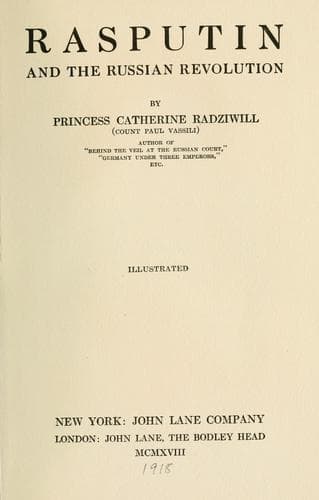
Rasputin and the Russian RevolutionRadziwill, Catherine, Princess
History
Rasputin and the Russian Revolution
Radziwill, Catherine, Princess
Rasputin, Grigorii Efimovich, 1869-1916; Soviet Union -- History -- Revolution, 1917-1921
mortals, which it did not succeed in doing, because it had been brought
up too far from the world in general, represented by that portion
of humanity which suffers and which works in silence, to be able to
enter into its interests, and to make them its own. On the other
hand that same family gave the first signal of rebellion against the
system represented by the masters of the Palace of Tsarskoie Selo,
whom it applied itself to discredit with an energy which was the more
tenacious that it would have liked to be in their place. The Grand
Duchess Vladimir, especially, together with her two sons, who had never
cared for the Head of their dynasty, were the first ones to greet in
their house all the discontented people who abounded in the Russian
capital, and to deplore in their presence the scandal occasioned by
the strange conduct of the Empress. The Revolution which was to come
later on was prepared silently in the palaces of the very persons who
ought to have fought against it, as well as in the homes of those old
servants of the monarchy, who would have wished to save it from the
disaster, which they saw but too well, was fast overtaking it, but who
had to own themselves powerless to do so, and had to acknowledge with
sorrow and with shame that it was discrediting itself a little more
with each day that was passing. The nation, on its side, was preparing
itself for the impending struggle. The systematic manner in which the
labour party in Russia organised itself in view of the approaching
Revolution, has never been sufficiently known or appreciated abroad.
It has constituted for those who have followed the slow evolution
which was the consequence of the premature revolutionary movement that
had failed in 1905, one of the most interesting political problems
of the twentieth century. I have lived in Russia during the years
which have immediately preceded the war, and I have been in personal
relations with some of the leaders of this party. I can therefore
write about it from the point of view of a witness eager to watch the
slow transformation, which out of a party essentially violent in its
view and aspirations had produced a political faction, sufficiently
ripened and saddened by the unsuccesses of its first fight not to seek
elsewhere than in a too rapid solution the end of the difficulties
under which it had been condemned to develop itself. It was quite
sufficient to have witnessed the manifestations that used to take place
each first of May, to come to the conclusion that the workman who was
walking the streets, singing and carrying revolutionary flags, in 1906,
was quite a different man from the one who indulged in manifestations
of the like kind in 1913 and 1914. The general strike which preceded
the war by a few weeks upon which the Germans founded so many useless
hopes was, notwithstanding its revolutionary character, rather an
expression of opinion on the part of a powerful and perfectly well
Public-domain text, read in full here on John Shaqi.
Reviews
Reviews
No reviews yet
Be the first to share your thoughts on this work.
Elsewhere in the archive
Join the Discussion
Join the discussion
Sign in to leave a comment or review.
Sign InorCreate an account