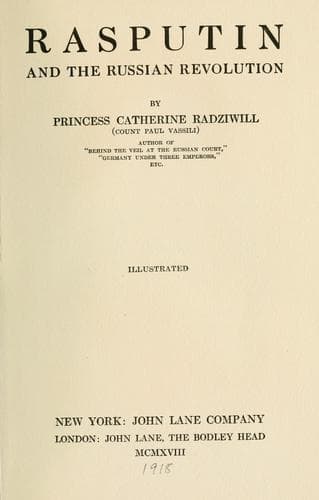
Rasputin and the Russian RevolutionRadziwill, Catherine, Princess
History
Rasputin and the Russian Revolution
Radziwill, Catherine, Princess
Rasputin, Grigorii Efimovich, 1869-1916; Soviet Union -- History -- Revolution, 1917-1921
organised party than a rebellion against authority. The workman had
at last realised that he had got the future for him, provided he did
not allow his natural impatience to carry him too far, and that he
could resist the temptation to proceed too quickly with the plans
which he had formed. He had also realised another thing, and that was
that neither the liberals nor the octobrists, nor the party called
that of the cadets, nor even the revolutionary socialists, were strong
enough to constitute a government, and that all the plans they were
continually talking about, would only end in speeches more or less
empty and devoid of practical common sense. The workman applied himself
to avoid mistakes, which perhaps he had noticed before he had quite
grasped their importance. He understood on the other hand perfectly
well the fact that the immense industrial movement, which had developed
itself during the years that had followed immediately upon the war with
Japan, was bound to increase still further in importance, and that the
future belonged to those who would be able to profit by it, to guide
it, and to direct it in the sense of a great and general reform of the
different abuses which had corrupted all the higher classes of the
nation. The number of factories which suddenly arose everywhere, the
speculation that followed upon the rise in the value of all kinds of
industrial securities, and the knowledge that the workman very quickly
acquired as to the different means thanks to which the fortunes of
so many people come, no one knew from whence, had been edified, gave
him a strength which became the more formidable that he was compelled
to remain silent in presence of so many spectacles that revolted
his sense of integrity. In regard to this particular point, the
impossibility to hold public meetings proved a blessing in disguise for
the development of the activity of the labour party, because it allowed
it to proceed in secret to a propaganda that became the more dangerous
for the security of the government in that there existed no one able
to point out to those among whom it flourished its perilous, and even
to a certain extent, its disastrous sides. Under the very eyes of the
police, the mass of the workmen employed in the different factories
scattered all over Petrograd, prepared itself for the mission which it
felt but too well was bound sooner or later to devolve upon it; so that
whenever it allowed its voice to be heard, it was always with prudence,
and even with a certain amount of cautious wisdom that prevented the
general public and the authorities noticing how strong and powerful it
was getting, and what a wonderful instrument it would prove later on,
in the hands of those who in the meanwhile were leading it in secret,
until the day when, thanks to their help, it would be able in its turn
to lead others.
Public-domain text, read in full here on John Shaqi.
Reviews
Reviews
No reviews yet
Be the first to share your thoughts on this work.
Elsewhere in the archive
Join the Discussion
Join the discussion
Sign in to leave a comment or review.
Sign InorCreate an account