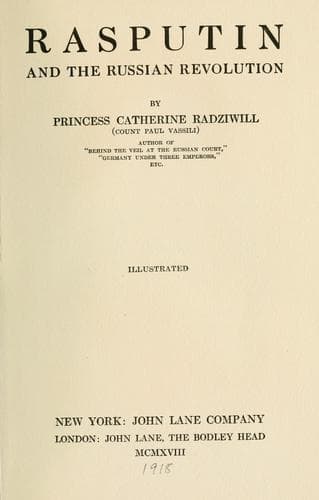
Rasputin and the Russian RevolutionRadziwill, Catherine, Princess
History
Rasputin and the Russian Revolution
Radziwill, Catherine, Princess
Rasputin, Grigorii Efimovich, 1869-1916; Soviet Union -- History -- Revolution, 1917-1921
Here I must make a pause, and try to analyse the real part played in
the drama by the unfortunate Sovereign on the head of whom so many
curses have been showered. I do not believe that it was in order to
hand over to her own native country, the one which had become hers by
marriage, that Alexandra Feodorovna lent herself to the intrigue in
which it is unfortunately an uncontested fact that she took an active
share. It seems to me, so far as I can judge of things which did not
take place in my presence, that her intentions were sincere according
to her lights. She was not an intelligent woman by any means, and what
she possessed in the way of intellect had disappeared in a vanity
and haughtiness of which it is hardly possible to form an adequate
idea. She cared only for her crown, and for autocratic power over
her subjects, and under the influence of those who represented to her
that the least concession to the spirit of the times was bound to
further the cause of a revolution which she abhorred, she had awarded
her protection to this reactionary party represented by men like
Sturmer, Protopopoff, and others of the same kind. She had preached
to her husband whenever she had had the opportunity for doing so, the
necessity to stand firm, and never to sacrifice one fraction of the
principle of absolute power over his subjects. She had pointed out
to him on every possible occasion the example of Louis XVI., who had
been beheaded, because he had not had sufficient courage to resist
to the pressure exercised over him by the revolutionary elements in
the French monarchy. She did not grasp in the very least that times
were different, that ideas as well as men had changed, and that a
sovereign who in a moment of danger does not seek help from his people,
or try together with them to find a solution to the difficulties of
a threatening situation, courts an inevitable ruin. The Empress has,
without any doubt being allowed as to this point, been the direct cause
of the misfortunes as well as of the fall of her husband, and probably
when history will be called upon to judge her, it will show itself even
more severe in regard to her and to her conduct than her contemporaries
have been, because she has certainly done more to destroy the respect
of Russia for the throne to which she had been raised than the most
violent revolutionary attacks that were ever directed against it.
Instead of trying to bring her consort nearer to the nation at
whose head he stood, she only inspired him with suspicions and even
with dislike for this nation, or at least for the best among its
representatives.
Public-domain text, read in full here on John Shaqi.
Reviews
Reviews
No reviews yet
Be the first to share your thoughts on this work.
Elsewhere in the archive
Join the Discussion
Join the discussion
Sign in to leave a comment or review.
Sign InorCreate an account