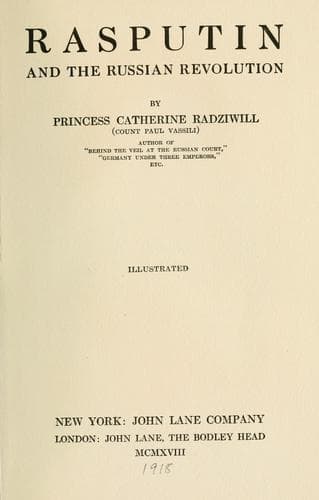
Rasputin and the Russian RevolutionRadziwill, Catherine, Princess
History
Rasputin and the Russian Revolution
Radziwill, Catherine, Princess
Rasputin, Grigorii Efimovich, 1869-1916; Soviet Union -- History -- Revolution, 1917-1921
There happened circumstances when the Empress interfered directly
in the affairs of the State, and persuaded the Czar to do what she
required of him; as, for instance, the exile in Siberia, this Siberia
whither she was to be sent herself, and the arbitrary arrest of several
leaders of the labour party, whom, under some futile pretext or other,
the government threw into prison a few weeks before the outbreak of the
Revolution, in spite of the indignant protestations made by the Duma
on the subject. It was also Alexandra Feodorovna, who, on the advice
of the metropolitan Pitirim, a creature of Rasputin, who had caused
him to be appointed to the See of Petrograd, the most important one in
the Empire, persuaded the Emperor to follow the advice of the minister
Protopopoff to prorogue the Duma, and to arm the police with machine
guns, in view of a possible revolt of the inhabitants of the capital
against the government, a fatal and most imprudent measure, if there
ever was one, which decided the fate of the Romanoff dynasty.
In this last occurrence, it was less out of fear of the debates that
might take place in the Duma, than because he wanted to have his
hands untied in regard to the conclusion of peace for which he had
been working ever since he had been called to the ministry of the
interior, that Protopopoff induced his Sovereign to resort to a measure
absolutely devoid of common sense, and the only effect of which could
be to add fuel to a fire that had been smouldering for months, if
not years. It proved fatal for everybody, and it is still a question
whether it was not to be more fatal for Russia than anything else which
Nicholas II. had ever done, because it has thrown her into an era of
revolution and of trouble, for which she was neither prepared nor ripe.
At that time I am writing about, the members of the Imperial family
together with the aristocracy were beginning to get more and more
alarmed at the manner in which events were unfolding themselves, and
were wondering as to what could be done to put an end to the influence
of the Empress and of her favourites. One of the oldest, and the only
surviving personal friend of the late Czar Alexander III., Count
Vorontzoff Dachkoff, when he visited the Emperor to take leave of him,
on his resignation of the functions of Viceroy of the Caucasus, had
tried to remonstrate with him on the subject, and to point out to him
the necessity of getting rid of Rasputin and of the followers of the
latter. He had known Nicholas II. as a child, and he could therefore
talk with him more familiarly than any one else in Russia: “I must tell
you the truth,” he said. “Do you know that, thanks to your Rasputin,
you are going to your ruin and endangering the throne of your son?”
The old soldier, who had served under four sovereigns, became quite
eloquent in his speech. The Czar listened to him in silence, and at
last exclaimed almost with a sob: “Why did God lay upon me such a heavy
burden?”
Public-domain text, read in full here on John Shaqi.
Reviews
Reviews
No reviews yet
Be the first to share your thoughts on this work.
Elsewhere in the archive
Join the Discussion
Join the discussion
Sign in to leave a comment or review.
Sign InorCreate an account