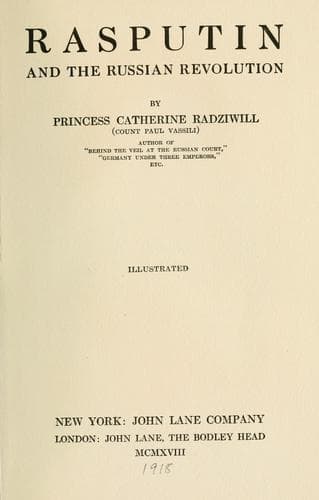
Rasputin and the Russian RevolutionRadziwill, Catherine, Princess
History
Rasputin and the Russian Revolution
Radziwill, Catherine, Princess
Rasputin, Grigorii Efimovich, 1869-1916; Soviet Union -- History -- Revolution, 1917-1921
“Your Majesty is probably aware of the terrible conditions in which
our army finds itself placed in Persia at the present moment, and of
the many illnesses and epidemics of all kinds that are raging there.
To expose the Grand Duke to those dangers is simply compassing his
ruin, because he can only come out of such a trial a physical and moral
wreck, and surely the kind heart of Your Majesty will take pity on a
youth for whom you have had some affection in the past, and in regard
to whom you have always shown yourself a kind father. We pray to God to
soften the feelings of Your Majesty, and to induce you to alter your
decision, and to show some mercy to your own kinsman.”
To this letter was received on the next day the following reply:
“No one has the right to commit a murder. I am aware that many people
are suffering now from qualms of conscience, because it is not only
Dmitry Pavlovitsch who is mixed up in this business. I am surprised at
your daring to address me in such terms. Nicholas.”
The Grand Duke had to submit. He departed for the Persian front,
accompanied by an officer who had received strict orders to oppose any
attempt that he might feel tempted to make, in order to escape his
doom. A curious incident, very characteristic of the state of mind
prevailing in the capital at that time, then occurred. The comrades of
this officer, upon hearing of his appointment, obliged him to resign
his commission, considering that he had disgraced himself by accepting
such a mission.
In the meanwhile the body of Rasputin was taken at night to Tsarskoie
Selo and buried in a small chapel which had been erected some years
before by the Empress, quite close to the palace which she inhabited.
Troops surrounded it so as to prevent any one getting near to it,
whilst the ceremony lasted, and the funeral was attended by the
Emperor, the Empress, and the intimate friend of the latter, Madame
Vyroubieva. Alexandra Feodorovna used to go every afternoon to pray on
the grave of the man whose influence had proved her bane, until at last
the Revolution imprisoned her, and threw to the winds the ashes of the
greatest enemy that the dynasty of the Romanoff’s had ever known. When
the body was exhumed by the angry populace, one found on its breast
a sacred image, bearing the names of the Empress, and of her three
daughters, last memento of an affection which had proved so fatal to
those who had nursed it.
Public-domain text, read in full here on John Shaqi.
Reviews
Reviews
No reviews yet
Be the first to share your thoughts on this work.
Elsewhere in the archive
Join the Discussion
Join the discussion
Sign in to leave a comment or review.
Sign InorCreate an account