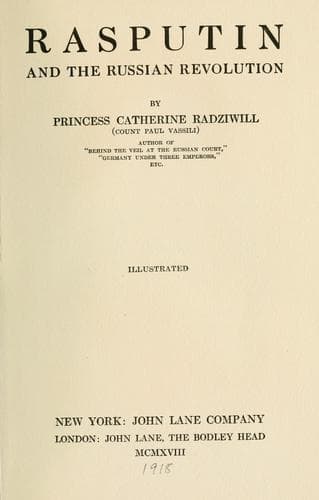
Rasputin and the Russian RevolutionRadziwill, Catherine, Princess
History
Rasputin and the Russian Revolution
Radziwill, Catherine, Princess
Rasputin, Grigorii Efimovich, 1869-1916; Soviet Union -- History -- Revolution, 1917-1921
The murder of Rasputin had one very clear and definite object, that of
ridding the Czar of an individual who had sullied his honour. Those who
were courageous enough to send him into eternity had nursed the hope
that once this evil influence had disappeared, the counsels of wisdom
would prevail, and Nicholas II. might be at last brought to understand
that his duty required of him to look bravely into the face of the
situation in which he had been thrown together with the Empire over
which he ruled. Until that time, no one had been able to talk seriously
with him, with hopes of being listened to. The Emperor had acquired
the habit of never giving an immediate reply to any proposition that
was submitted to him, but deferred his decisions, in order to discuss
them first with the Empress, who in her turn consulted her favourites
Sturmer and Protopopoff, who had taken to a certain extent the place
left empty by Rasputin’s disappearance. They were all of them working
together towards the conclusion of a separate peace with Germany,
because they believed that if once this were achieved they would be
able to recall the army from the front, and to use it against the Duma
and the nation, establishing with its help upon a sounder and firmer
base their own power and might. None among them gave a thought to the
possibility that the troops might practise with the people, and work
together with it towards the downfall of the government and of the
dynasty.
This desire of the Empress to bring about, no matter at what cost,
the ending of the war, was suspected by a good many people. A few
officers in possession of important commands had an inkling of it,
and the leaders of the labour party had also heard about it. The last
named, who had worked more than any other class of the nation for the
continuation of the struggle in the material sense of the word, and who
wanted to avenge their sons fallen before the enemy, became anxious
at the possibility of such a peace being concluded; and very distinct
threats were uttered not only in Petrograd, but all over Russia,
against the Ministers, the Emperor, and especially the Empress. This
explains, apart from other reasons, why the murder of Rasputin was
hailed with such joy. One hoped that his removal would put an end to
a state of things out of which could only result disaster, shame and
misfortune.
Public-domain text, read in full here on John Shaqi.
Reviews
Reviews
No reviews yet
Be the first to share your thoughts on this work.
Elsewhere in the archive
Join the Discussion
Join the discussion
Sign in to leave a comment or review.
Sign InorCreate an account