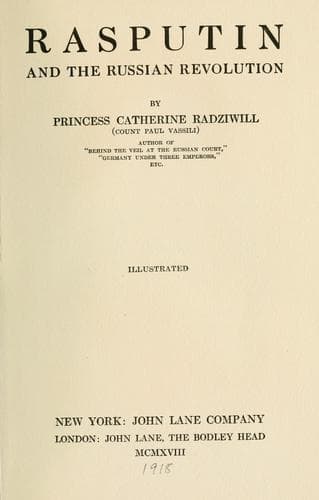
Rasputin and the Russian RevolutionRadziwill, Catherine, Princess
History
Rasputin and the Russian Revolution
Radziwill, Catherine, Princess
Rasputin, Grigorii Efimovich, 1869-1916; Soviet Union -- History -- Revolution, 1917-1921
This discredited Monarch, and his hated and despised Empress, by
whom were they surrounded during those eventful days which preceded
their fall? Who were the people whom they trusted, and on whom they
relied? Whom do we see advising them? Only a handful of flatterers,
of sycophants, always ready to turn against him and to betray them at
the first opportunity, together with Ministers devoid of any political
sense, and without any knowledge or comprehension of the position
into which the country had been allowed to drift; without any courage
or energy, incapable of imposing themselves or their opinions upon
the masses, and of convincing them of the soundness of their views;
incapable even of subduing these masses by the use of sheer force.
Apart from these flatterers and these weak advisers, whom could
Nicholas II. and his Consort trust and believe in? Whom had they got
beside them? A discontented army, that was too thoroughly weary of
seeing itself neglected and passed over like a negligible quantity,
whilst it was fighting for dear life on the frontiers, and who had lost
all wish to go on with what appeared to it to have become a hopeless
struggle; a few functionaries who cared for nothing but their own
advantage or advancement; a handful of adventurers in quest of places,
influence and riches, especially of the latter; a police always ready
to listen to every kind of low denunciation; that had abused its power,
that had destroyed, thanks to its criminal activity, every sense of
personal security in the nation, and that prosecuted only those who
did not pay it sufficiently to leave them alone. Blackmailers, spies,
and valets; this was all that was left to the Czar of All the Russias,
to watch over him. They were the only people on whom he could rely,
and even they would only remain faithful to him as long as the supreme
power would remain, at least nominally, in his hands. His family, as
we have seen, detested the Empress, and was ready and prepared to side
against him on the first notice of his downfall, which it effectively
did. What was left in Petrograd of aristocracy had withdrawn itself
from him, lamenting over evils which it knew itself powerless to allay,
and had come to the sad conclusion that the further it kept from
Tsarskoie Selo the better it would be for everybody. The Emperor stood
alone, forsaken by all those who under different circumstances would
have considered themselves but too honoured to die for him, let alone
defend him against his foes. Alexandra Feodorovna had created a desert
around her husband, and, thanks to her, there was hardly a Russian left
in the world who did not for some reason or other curse the Sovereign
whom Providence had destined to become in all human probability the
last of the Romanoff’s crowned in Moscow. Nicholas II. imagined that
he could rely on the devotion and the loyalty of his army. He forgot
that this army was no longer the one that had acclaimed him with such
Public-domain text, read in full here on John Shaqi.
Reviews
Reviews
No reviews yet
Be the first to share your thoughts on this work.
Elsewhere in the archive
Join the Discussion
Join the discussion
Sign in to leave a comment or review.
Sign InorCreate an account