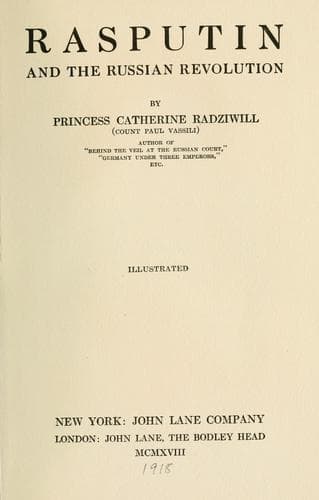
Rasputin and the Russian RevolutionRadziwill, Catherine, Princess
History
Rasputin and the Russian Revolution
Radziwill, Catherine, Princess
Rasputin, Grigorii Efimovich, 1869-1916; Soviet Union -- History -- Revolution, 1917-1921
enthusiasm at the beginning of the war. Most of the officers who had
been in command of it at the time had fallen on some battle field or
other; the soldiers too had disappeared, and the young recruits who had
taken their place had been reared in different ideas, and were ignorant
of the old discipline which had inspired the former regiments whose
original contingents had been slain. The army had become a national
one from the Imperialist it had been before; it was composed of the
same elements of discontented minds who before they had been called
to the colours had freely discussed the conditions under which the
war was being fought, and who had noticed better than it would have
been possible for them to do at the front, the mistakes of those in
command, the remorseless dilapidation of the Public Exchequer which was
going on everywhere, together with all the faults and the carelessness
that had brought about all the disasters which had fallen upon the
nation. This army could no longer nurse, in regard to the Czar, the
veneration and almost religious respect which had animated it in
earlier days. It had perceived at last that he was not at the height
of the duties and responsibilities which had devolved upon him, and as
a natural consequence of the fall of the scales from its eyes it had
sided against him, together with the Duma, from which it was hoping
and expecting the salvation which its masters of the present hour were
unable to procure for it.
But whilst the whole of Russia was aware of this state of things,
Nicholas II. alone refused to see it. He felt afraid of appearing as
the weak man that he really was; he refused all the urgent entreaties
which were addressed to him, to appeal to his people, and to appoint
a popular and responsible Ministry, capable once he had called it to
power of requiring from him the fulfilment of his former promises,
which he had determined beforehand never to keep. He threw himself from
right to left, and from left to right, in quest of councillors after
his own heart, or rather after the heart of the Empress, because it was
she who finally decided everything; and he changed his Ministers with
a facility which was the more deplorable that those of the morrow did
not differ from the ones whom he had dismissed the day before, until at
last, thanks to his irresolution and to his obstinacy, he contrived to
discredit, not only in Russia, but also abroad and among his Allies,
the government of which he was the head, together with his own person
and the great Imperial might which he personified. At last even the
extreme conservative parties, who until then had been on his side,
joined the ranks of his enemies, and this defection of theirs made the
disaster an irremediable one, and the fatal catastrophe inevitable.
Public-domain text, read in full here on John Shaqi.
Reviews
Reviews
No reviews yet
Be the first to share your thoughts on this work.
Elsewhere in the archive
Join the Discussion
Join the discussion
Sign in to leave a comment or review.
Sign InorCreate an account