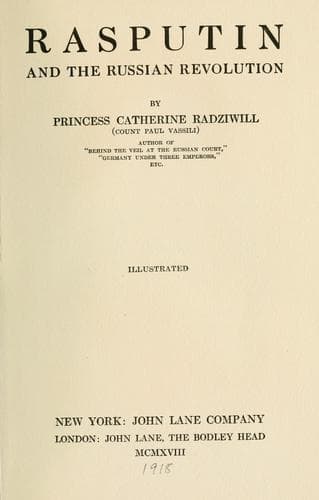
Rasputin and the Russian RevolutionRadziwill, Catherine, Princess
History
Rasputin and the Russian Revolution
Radziwill, Catherine, Princess
Rasputin, Grigorii Efimovich, 1869-1916; Soviet Union -- History -- Revolution, 1917-1921
After these debates, during which had been voted by an immense majority
the immediate release of the arrested workmen, Mr. Protopopoff rushed
to Tsarskoie Selo, the metropolitan Pitirim, and Mr. Sturmer (who had
remained a persona grata at Court, notwithstanding the fact that he
had been compelled to resign his former functions of Prime Minister)
accompanied him. A conference took place between them and the Empress,
towards the close of which Nicholas II. was asked to come in and
to listen to the decisions that had been arrived at, which he was
requested to sanction. This conference decided that the negotiations
already engaged with Germany in view of the conclusion of a separate
peace should be hastened; that the Duma should be prorogued for an
indefinite period of time, and the police armed with machine guns, in
order to be able to crush at once, by a display of its forces, every
popular manifestation that might be attempted in favour of a change of
government, should such manifestation take place in the capital.
Here I am touching in this short sketch of the Russian Revolution
upon a point which is still dark, the point concerning this separate
peace with Germany, about which there arose at that time so much
talk in Petrograd. The idea of a step of that kind, which would have
constituted an arrant treason in regard to the Allies of Russia, had
been conceived first in the brain of Mr. Sturmer, to whom most probably
it had been suggested by his confidential friend and secretary, Mr.
Manassevitsch-Maniuloff, about whom I have already spoken in the first
part of this book, and who, after the murder of Rasputin, had been
finally brought to trial and sentenced to eighteen months hard labour
for blackmail. He had always been in the employ of Germany, and he
had spoken to his patron of the necessity for putting an end to a war
which, if it went on much longer, might endanger the very existence of
the dynasty. Mr. Sturmer had also sympathies for the “Vaterland,” and
he was but too glad to act according to the hints which were given to
him by a man in whom he had every confidence. He found an unexpected
ally in Rasputin, who in his turn induced the Empress through Madame
Vyroubieva to rally herself to his opinion, which was a relatively easy
thing to do, considering the fact that she had been already, of her
own accord, working towards a reconciliation between the Romanoffs and
the Hohenzollerns, the only people whom she thought of any consequence
in the whole affair. The difficulty consisted, however, in finding
a person willing and disposed to act as intermediary in so grave a
matter. Rasputin knew Protopopoff, discussed the subject with him, and
found him quite ready to enter into the views which he expounded to
him.
Public-domain text, read in full here on John Shaqi.
Reviews
Reviews
No reviews yet
Be the first to share your thoughts on this work.
Elsewhere in the archive
Join the Discussion
Join the discussion
Sign in to leave a comment or review.
Sign InorCreate an account