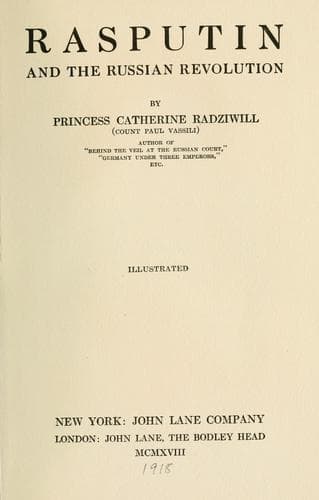
Rasputin and the Russian RevolutionRadziwill, Catherine, Princess
History
Rasputin and the Russian Revolution
Radziwill, Catherine, Princess
Rasputin, Grigorii Efimovich, 1869-1916; Soviet Union -- History -- Revolution, 1917-1921
At that time Mr. Protopopoff was vice president of the Duma. No
one knew exactly how he had contrived to secure his election as
such, considering his reputation of reactionary and especially of
opportunist. He had, however, succeeded in getting himself appointed,
and the fact that he held this position gave him a certain weight and
prestige abroad. He was given very precise instructions as to what he
was to do, and started with several of his colleagues of the Duma for
England, under the pretext of returning the visit which some members
of the English House of Commons had paid to Petrograd a few months
earlier. On his way back, he stopped at Stockholm as I have already
related, conferred there with an agent of the German Foreign Office
called Mr. Warburg, and settled with him the conditions under which an
eventual peace could be concluded. After this Protopopoff returned to
Russia, where, however, the story of his Swedish intrigues had already
become known so that he was awarded a very poor welcome by his friends.
People believed then that his political career had come to an end,
when, just at this juncture, the most important post in the Russian
Empire, that of Minister of the Interior, became vacant, thanks to the
dismissal of Mr. Chvostoff who had tried to get rid of Rasputin with
the help of the monk Illiodore, and, to the general stupefaction of the
world, the place was offered to Mr. Protopopoff by the Empress herself.
By that time one had become used in Russia to every possible surprise
in regard to the appointment of Ministers, and nothing that could
happen in that line astonished those (and they were legion) who knew
that it was a gang of adventurers that was ruling the country. The rise
of Mr. Protopopoff was not therefore considered by them as something
out of the way, but in parliamentary circles it gave rise to deep
indignation; an indignation which eventually found its way into the
press, where, however, it was very quickly suppressed by the censor,
and also in the various speeches uttered in the Duma, during which
allusions were made for the first time to the unhealthy influence
exercised by the Empress over her husband.
Public-domain text, read in full here on John Shaqi.
Reviews
Reviews
No reviews yet
Be the first to share your thoughts on this work.
Elsewhere in the archive
Join the Discussion
Join the discussion
Sign in to leave a comment or review.
Sign InorCreate an account