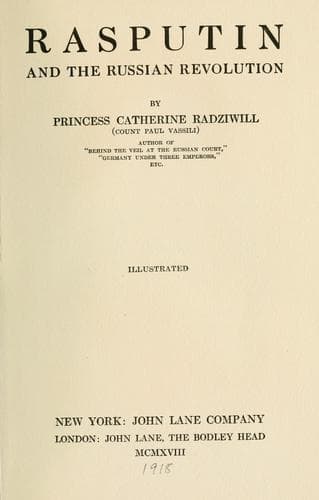
Rasputin and the Russian RevolutionRadziwill, Catherine, Princess
History
Rasputin and the Russian Revolution
Radziwill, Catherine, Princess
Rasputin, Grigorii Efimovich, 1869-1916; Soviet Union -- History -- Revolution, 1917-1921
The first thing that was done by the Duma was to refuse to disperse and
to resist the ukaze of the Czar that had prorogued its debates for an
indefinite time. The socialist deputies went about trying to get the
population of Petrograd to join in the vast movement of revolt they
meant to bring about. The latter was but too willing to do so, and the
want of provisions was the pretext which the people took to organise
vast meetings, and a strike in all the factories. Great masses of men
and women paraded the streets, and were dispersed by a formidable
police force which had been assembled by Mr. Protopopoff and armed with
machine guns that were used against the crowds, whenever these did not
obey immediately the injunctions to disperse given to them by special
constables and Cossacks gathered together in all the principal streets
and squares of the capital. The regular troops had been consigned in
their barracks and ordered to keep themselves ready to lend a hand
to the police. But the unexpected happened. The soldiers had been
worked upon by delegates from the workmen, and they declared that they
would not obey orders, should any be given to them, to fire upon the
populace assembled in the streets. The latter seemed quite sure of
impunity, because notwithstanding the preparations made by the police
to quell the revolutionary movement, the existence of which was already
recognised everywhere, it refused to disperse, and on the contrary
proceeded to commit the only acts of violence which were performed
during the course of the mutiny. It threw itself on the prisons where
political offenders were confined, plundered and burned them, and
liberated their inmates. A few other excesses were performed, upon
which the Duma constituted itself an executive committee, which assumed
the task of restoring order in Petrograd.
In the meanwhile, the Czar who had been kept in total ignorance of what
was going on in the capital, had left Tsarskoie Selo for headquarters,
after having signed the prorogation of the Chambers. In his absence,
it was the Empress who was left sole mistress of the situation, and
it is to her and to Protopopoff that were due all the attempts at
repression which happily for all parties concerned were not allowed to
be executed, at least not in their entirety.
Public-domain text, read in full here on John Shaqi.
Reviews
Reviews
No reviews yet
Be the first to share your thoughts on this work.
Elsewhere in the archive
Join the Discussion
Join the discussion
Sign in to leave a comment or review.
Sign InorCreate an account