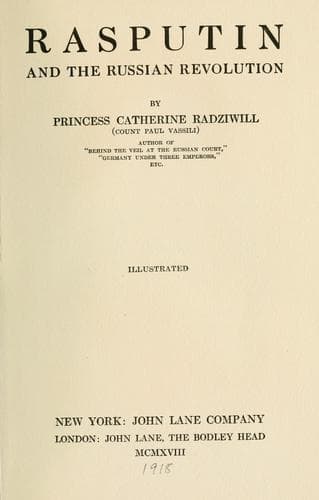
Rasputin and the Russian RevolutionRadziwill, Catherine, Princess
History
Rasputin and the Russian Revolution
Radziwill, Catherine, Princess
Rasputin, Grigorii Efimovich, 1869-1916; Soviet Union -- History -- Revolution, 1917-1921
Mr. Rodzianko was about the last man whom one would have suspected of
being possessed of the necessary determination to resort to a “Coup
d’Etat.” He was a Chamberlain of the Czar; he had been brought up in
monarchical traditions, and during his whole life he had submitted
to the one which, in Russia, placed the Sovereign in the light of
something holy and sacred before his subjects. He was respected but
did not enjoy an immense authority in the Chamber that had never
taken quite kindly to him, not thinking him possessed of sufficient
courage to fight its battles with efficiency. It is probable that
he felt terrified rather than anything else, at the prospect which
the communication of Mr. Kerensky opened before him, but things
had advanced too far for him to be able to withdraw. There was no
alternative left but to perish oneself, or to destroy others. Mr.
Rodzianko called together a meeting of several deputies belonging to
the moderate parties, with whom he discussed the situation. They very
quickly came to the conclusion that if one entered into a struggle
with the government in this all important question of war and peace,
one would be backed up by the whole country, which did not wish to see
the war come to an end until the enemy had been driven out of Russian
territory. There was also another thing which added itself to all the
different questions roused by the discovery of the intentions of the
Court. It was the determination of the radical groups of the Duma to
proceed to the “Coup d’Etat” on their own accord, and no matter under
what conditions, with or without the help of the moderate elements
in the Assembly. This might have become extremely dangerous, as they
had behind them the whole mass of the working population of the
capital. The question had therefore to be considered as to whether
the Revolution was to be made with the concurrence of all the parties
represented in the Duma, or by the radical socialists alone, who,
in the latter case, would have become the absolute masters of the
situation, and might have pressed for the immediate proclamation of
a Republic which could easily have degenerated into an anarchy, and
which in the best of cases would have lacked the necessary dignity,
capable of giving it prestige and authority at home and abroad. Mr.
Rodzianko found himself placed in the presence of a dilemma of a most
difficult kind and nature. He took the only decision possible under the
circumstances, he boldly placed himself at the head of the movement
and constituted a provisional government, in place of the one that had
foundered under the weight of the contempt of the whole nation.
Public-domain text, read in full here on John Shaqi.
Reviews
Reviews
No reviews yet
Be the first to share your thoughts on this work.
Elsewhere in the archive
Join the Discussion
Join the discussion
Sign in to leave a comment or review.
Sign InorCreate an account