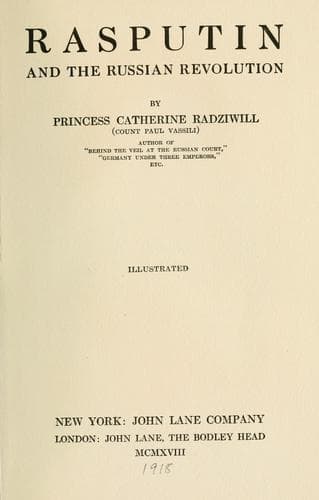
Rasputin and the Russian RevolutionRadziwill, Catherine, Princess
History
Rasputin and the Russian Revolution
Radziwill, Catherine, Princess
Rasputin, Grigorii Efimovich, 1869-1916; Soviet Union -- History -- Revolution, 1917-1921
The new executive committee displayed considerable patriotism at this
juncture. It might have provoked enormous enthusiasm in its favour had
it revealed what it knew concerning the peace negotiations entered into
by the Empress, but this might have given a pretext for explosions
of wrath on the part of the mob, which could easily have ended in
excesses, compromising the dignity of the Revolution. It therefore
decided to keep back from the public its knowledge on this subject, and
contented itself with arresting the ministers, and all the persons whom
it suspected of having lent themselves to this intrigue, and it simply
empowered two members of the Duma, Mr. Goutschkoff and Mr. Schoulguine,
to proceed to Pskov, where it was known that the Emperor had arrived
the day before, to ask the latter to abdicate in favour of his son.
Nicholas II. in the meanwhile had arrived at headquarters which were
then in Mohilev, and where no one seemed to know anything about what
was going on in Petrograd. None of the people about him even suspected
that a storm was brewing which would overturn in a few hours a power
which they considered far too formidable for anything to be able to
shake. The only person who was kept informed of the course which events
were taking was the head of the Staff, General Alexieieff, who had
been won over from the very first to the cause of the Revolution, and
who, if one is to believe all that one hears, played all the time a
double game. It was he who received all the telegrams addressed to
the Emperor, and who communicated them to him. The latter at last was
shaken out of his equanimity, and gave orders to prepare his train
to return to Tsarskoie Selo. He took this decision in consequence
of a message from the commander of the Palace, addressed to General
Voyeikoff the head of the Okhrana, where the latter was advised that
the presence of the Sovereign was necessary, because the troops of the
garrison in the Imperial residence had mutineed, and the safety of the
Empress and of her children was endangered. But in spite of the orders
given to press the departure of the Imperial train it somehow could not
be got ready as quickly as was generally the case, so that it was only
during the night from the 12th to the 13th of March, that it started
at last. It went the usual route as far as the station of Lichoslav,
where it was met with the news that a revolutionary government had been
formed at Petrograd which had seized the railway lines and appointed
a deputy to take them in charge. Another telegram from the military
station master of the Nicholas station in Petrograd instructed the
officials at Lichoslav to send the Imperial train to Petrograd, and not
to Tsarskoie Selo. This was communicated to General Voyeikoff, who,
however, gave directions not to heed this warning, but to proceed to
Tsarskoie Selo, as had been arranged at first. At twelve o’clock at
night the Imperial train reached Bologoie. There a railway official
Public-domain text, read in full here on John Shaqi.
Reviews
Reviews
No reviews yet
Be the first to share your thoughts on this work.
Elsewhere in the archive
Join the Discussion
Join the discussion
Sign in to leave a comment or review.
Sign InorCreate an account