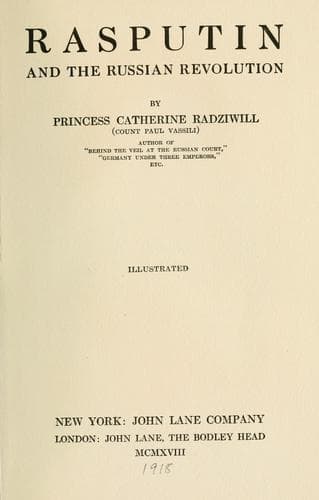
Rasputin and the Russian RevolutionRadziwill, Catherine, Princess
History
Rasputin and the Russian Revolution
Radziwill, Catherine, Princess
Rasputin, Grigorii Efimovich, 1869-1916; Soviet Union -- History -- Revolution, 1917-1921
informed the persons in charge of it that Tosno and Lioubane were in
possession of the troops which had mutineed against the government, and
that it might be dangerous to proceed any further. General Voyeikoff
would not listen to this advice, and the train went on to the station
of Vichera, where it had perforce to stop. The General was told that
the first train which always preceded the one in which the Sovereign
was travelling had been seized by the insurgents, and the members of
the Imperial suite who were travelling in it had been arrested and
conveyed under escort to Petrograd.
The Czar was awakened. General Voyeikoff informed him that it was
impossible to proceed to Tsarskoie Selo, because the railway line was
in the hands of the revolutionaries. It was then decided to go to
Pskov, where commanded General Roussky, on whose fidelity the Sovereign
believed that he might rely.
But Roussky had been won over to the cause of the Duma, notwithstanding
the fact that he had been loaded with favours by Nicholas II. When the
latter reached Pskov, where the General met him at the railway station,
the troops there had already been sworn over by their commander
in favour of the Revolution, and were quite ready to enforce its
decisions. The Czar knew nothing about this, and after a few moments’
conversation with Roussky, who acquainted him superficially with the
spirit reigning in the army, he declared to him that he consented to
call together a responsible Cabinet chosen out of the principal leaders
of the different parties in the Duma. But the General replied that
he feared this concession came too late, and that it would no longer
satisfy the country or the army.
On the 15th of March, Roussky succeeded in talking over the telephone
with Rodzianko, whom he informed of the details of his conversation
with Nicholas II. The president of the Duma then told him that the
former must decide to abdicate in favour of his son. They spoke for
more than two hours, and before their talk had come to an end, Roussky
had promised to do all that lay within his power, even to resort to
violence if need be, to further the views of the new government that
had taken up the supreme authority in Russia. He went then to make his
report to the Emperor, after which the latter signified his intention
to resign his throne to his little boy. The telegram announcing
this resolution, however, was not sent to Petrograd, because in the
meanwhile there had reached Pskov the news that the two delegates sent
by the Executive Committee, Mr. Goutschkoff, and Mr. Schoulguine, had
started on their way thither, in order to confer personally with the
Czar.
Public-domain text, read in full here on John Shaqi.
Reviews
Reviews
No reviews yet
Be the first to share your thoughts on this work.
Elsewhere in the archive
Join the Discussion
Join the discussion
Sign in to leave a comment or review.
Sign InorCreate an account