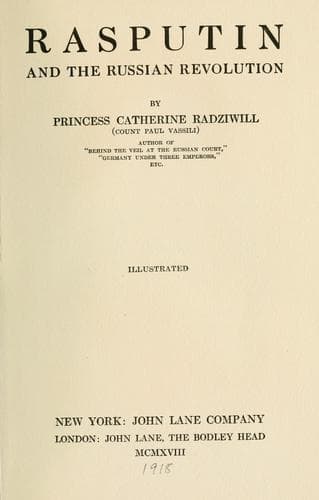
Rasputin and the Russian RevolutionRadziwill, Catherine, Princess
History
Rasputin and the Russian Revolution
Radziwill, Catherine, Princess
Rasputin, Grigorii Efimovich, 1869-1916; Soviet Union -- History -- Revolution, 1917-1921
she already contemplated the eventuality of a protest on the part of
Nicholas II. against the abdication to which he had been compelled is a
fact that can hardly be denied.
[Illustration:
_Copyright, Underwood & Underwood, N. Y._
BOLSHEVIKI SAILORS BURIED AT MOSCOW]
On the other hand the Grand Duke Michael could not have refused to act
as Regent for his nephew, though it was, in a certain sense, natural
for him to show some hesitation in accepting over the head of his
brother, and of his brother’s son, the crown of their common ancestors.
Personally the young Grand Duke did not care for power or for honours,
and the fact that he was married to a lady not belonging to any royal
house made it easier for him to resign himself to go on for the rest
of his existence living as a very rich private gentleman, which he had
done for a number of years. Pressure was also brought to bear upon
him, in the sense that he was told by persons interested in his not
accepting the throne that if the Constitutive Assembly which it was
proposed to call together, would elect him as Emperor, it would put
him later on in an easier position in regard to his nephew, the little
Grand Duke Alexis, and perhaps even allow him to secure the possession
of his empire to his own children after him. All these considerations
put together decided him not to avail himself of the immediate
opportunity which lay before him, of becoming the Czar of All the
Russias, and his proclamation on the subject may have been a wise one
from a personal point of view; it was, however, disastrous as regarded
the future fate of the dynasty, and it is doubtful now whether it will
ever be possible for a Romanoff to reign again in Russia.
The men who had made the Revolution were but too well aware of this
fact, and they proceeded, immediately after this act of Renunciation,
to organise the government of the country on the new lines which they
hoped and wished to follow in the future. Their lead was followed
by the nation with an enthusiasm which was so intense that it is no
wonder it came to collapse so soon as was the case. Russia seemed to
have been seized with a perfect frenzy; she was like a man who after
having been unjustly imprisoned for years does not know what to make
of his newly acquired freedom. People were literally mad with joy, and
inclined to find that everything their new government wished to do was
right. Hardly a voice of discontent arose during these first weeks that
followed upon the abdication of Nicholas II., and this absolution,
which was granted beforehand to the Ministry that had taken into its
hands the direction of the affairs of the country, allowed the men at
the head of it to decide the fate of the Sovereign whom they had helped
to overthrow, in a manner perhaps different from what would have been
done under other circumstances.
Public-domain text, read in full here on John Shaqi.
Reviews
Reviews
No reviews yet
Be the first to share your thoughts on this work.
Elsewhere in the archive
Join the Discussion
Join the discussion
Sign in to leave a comment or review.
Sign InorCreate an account