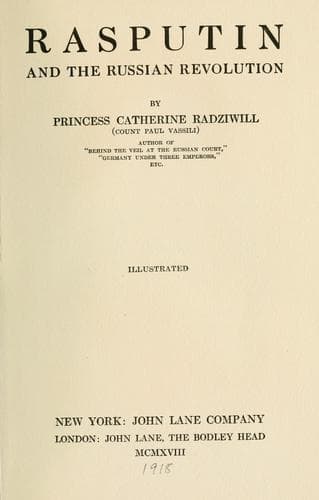
Rasputin and the Russian RevolutionRadziwill, Catherine, Princess
History
Rasputin and the Russian Revolution
Radziwill, Catherine, Princess
Rasputin, Grigorii Efimovich, 1869-1916; Soviet Union -- History -- Revolution, 1917-1921
had bequeathed to him, and which he had hoped to leave in his turn to
the son, whom fate and perhaps a mistaken feeling of affection had made
him despoil. He was not a bad man after all, although he had done many
a bad action; he was a tender father, and the thought of his child must
have added to the moral agony of his soul. By what means he was induced
to put his name at the bottom of the document which snatched away from
him the sceptre which he had dropped on his coronation day in Moscow,
remains still a mystery. Whether violence was used, or whether he was
persuaded by the eloquence of Roussky alone to give up the inheritance
of his race, is a thing which the future alone will reveal to us. It
is probable that he found himself compelled to come to his decision in
some way or other, and perhaps the threat to reveal the treason against
his allies in which he had participated, and which had been the work of
the Empress, was the most powerful argument which was used to oblige
him to sign his abdication. It was after all better to fall as a weak
man than to be covered with shame in the eyes of the world. He was
perhaps told to choose between degradation and dishonour, and he cannot
be blamed if he refused to resign himself to the latter.
CHAPTER V
The abdication of Nicholas II. was but one of the acts of a drama the
end of which is awaited with anxiety not only in Russia, but in the
whole of the world. Like everything else that he had ever done, it was
not performed in time, and it was badly executed. His own selfishness,
together with that of his wife, had brought about catastrophes which it
would have been relatively easy to avoid, by displaying a small amount
of political tact, good sense, and knowledge of the real requirements
of the Russian people. If the Czar had only been able to render to
himself an account of all that was going on around him, he would in
the interest of his dynasty have given up his son to the care of the
nation, and allowed him to take his place under the regency of the
Grand Duke Michael. This would have left Russia with a Czar, and not
allowed the people to see that they could very well exist without
one, which, as events have proved, has not been a particularly lucky
experience for them. This would also have ensured to Nicholas II. his
own liberty, because it is not likely that the Grand Duke Michael
would have had his brother and sister-in-law imprisoned. But neither
the dispossessed Monarch nor Alexandra Feodorovna were characters able
to rise to any heights of unselfishness. She had not the faintest
knowledge of the duties imposed upon her by her position as Empress
of Russia, and when she was placed between the alternative of seeing
her husband dethroned, or being compelled to give up his crown to their
child, she suggested a third one; that of substituting for the latter
his uncle, because she thought it would be easier for her later on
to overturn him than an Emperor who owned her for a mother; and that
Public-domain text, read in full here on John Shaqi.
Reviews
Reviews
No reviews yet
Be the first to share your thoughts on this work.
Elsewhere in the archive
Join the Discussion
Join the discussion
Sign in to leave a comment or review.
Sign InorCreate an account