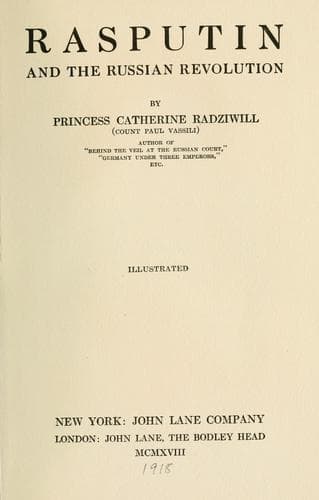
Rasputin and the Russian RevolutionRadziwill, Catherine, Princess
History
Rasputin and the Russian Revolution
Radziwill, Catherine, Princess
Rasputin, Grigorii Efimovich, 1869-1916; Soviet Union -- History -- Revolution, 1917-1921
The guard in charge of the Palace was changed; the telephone and
private post and telegraph office were taken over by a staff which
General Korniloff had brought over with him from Petrograd, and the
Empress was informed that she could not leave her rooms, even for a
walk, without the permission of the officer in charge of the troops
quartered in the Imperial residence. Though no orders had been issued
in regard to her personal attendants, yet the proud Princess was to
find that most of them had left her of their own accord. Her children
were all ill with a severe attack of measles, but this did not prevent
the salaried domestics who up to that moment had been so happy and
eager to be allowed the privilege of serving her, deserting her in the
hour of her need. The few friends she thought she could rely upon were
in prison. She was alone, all alone; and so she was to remain until the
end. The devotion with which Marie Antoinette was surrounded during the
tragedy of her existence was not known by Alexandra Feodorovna in the
drama of her life. She had made far too many enemies during the time
of her splendour and prosperity to find any one willing to cheer and
comfort her in the hour of her misfortune.
And the next day her husband was brought back to that Palace of
Tsarskoie Selo they had both liked so much, brought back a prisoner to
find her captive. What did she think when she saw him again? Did she
realise at last all the evil which she had done, all the misery, which,
thanks to her influence, had overtaken the Emperor whose crown she had
shared? How did she feel in presence of this catastrophe, of this wreck
of all her ambitions, plans and hopes? Outwardly she made no sign that
she understood the full significance of the events that had swallowed
her up in their depths, together with her pride and haughtiness. She
only manifested some emotion when told that the body of Rasputin had
been exhumed and burned publicly by exasperated crowds. Otherwise she
remained silent and if not resigned at least disdainful, even when she
was subjected to a close interrogation by General Korniloff, who was
deputed to examine her as to certain points in the correspondence which
Mr. Protopopoff had surrendered to the Duma. She denied to every one
the right to question her; she proudly refused to reply to the demands
addressed to her, and it was only when she was alone in her rooms that
she used to give way to terrible fits of despair at the loss of that
grandeur by which her head had been turned. Her children were so ill
that they could not even be told of the change that had taken place in
their existences and destinies. Her husband was too much crushed by the
weight of all the calamities which had fallen upon him to be able to
comfort her in any way. Her friends had left her, her attendants had
forsaken her, her family had abandoned her.... And it was thus, amidst
the stillness of sorrow and of anxiety, that the curtain was to fall
Public-domain text, read in full here on John Shaqi.
Reviews
Reviews
No reviews yet
Be the first to share your thoughts on this work.
Elsewhere in the archive
Join the Discussion
Join the discussion
Sign in to leave a comment or review.
Sign InorCreate an account