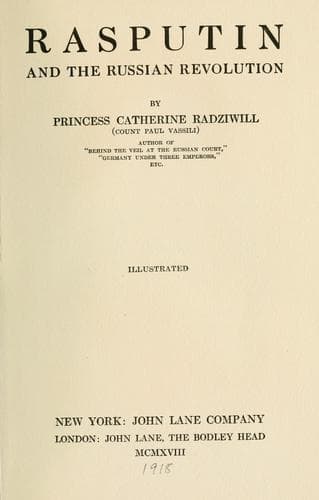
Rasputin and the Russian RevolutionRadziwill, Catherine, Princess
History
Rasputin and the Russian Revolution
Radziwill, Catherine, Princess
Rasputin, Grigorii Efimovich, 1869-1916; Soviet Union -- History -- Revolution, 1917-1921
upon the tragedy of Nicholas II. and of Alexandra Feodorovna, or at
least upon one of its principal acts....
PART III
THE RIDDLE OF THE FUTURE
CONCLUSION
More than one year has gone by since the events narrated in this book,
and it is possible now to throw a retrospective glance on them, as well
as on all the tragedies that have followed the fall of the Romanoffs.
It has been proved beyond doubt that it is not sufficient to destroy
a political system and to overturn a monarchy. These must be replaced
by something else, and it is this something else which Russia has been
vainly looking for during the last twelve months. After the abdication
of Nicholas II., successors had to be found to take up the power which
had been snatched out of his hands owing to the clamours of public
indignation at his weakness of character and want of comprehension of
the needs of his people. These successors, who were taken here and
there in the hazards of an adventure brought about by the intrigues
of a few and by the cowardice of many, who were they? What did they
represent? And what elements of strength did they possess? They were
called upon to take the direction of the destinies of their Fatherland
in an hour of national crisis, such as it had never known before in
the whole course of its history, and to try to save a situation which
had become already so entangled that it had almost reached the limits
of desperation. It is possible to-day to pass judgment on the first
government that assumed authority after the fall of the unfortunate
Czar. And, much as one would like to think well of it, it must be
admitted that though it was composed of men of great talent and
integrity, it did not possess one single character determined enough
and strong enough to deliver it from the demagogues who had secured an
entry into it, and from the anarchist elements that had tried from the
very outset to impose themselves upon it and their doctrines. Moreover
these men were devoid of experience, and they believed sincerely (there
can be no doubt as to this point) but absolutely erroneously, that it
was sufficient for them and their party to come to the foreground in
order to bring about in Russia an era of bliss such as exists only in
fairy tales. Among them was found Alexander Kerensky, a Socialist, one
of the leaders of the Labour Party, an indifferent lawyer but a most
eloquent speaker, who, better than any one else in Russia, understood
the art of stirring the souls and appealing to the passions of the
crowds upon which he relied to keep him in power; and who by his
wonderful speeches could easily lead these crowds upon any road he
wished to have them follow, though it might not land them where they
imagined they were going. Kerensky imposed himself upon the Revolution
in the same way he imposed himself upon a jury, and he treated it as
he would have treated a jury during a criminal trial. Of politics he
Public-domain text, read in full here on John Shaqi.
Reviews
Reviews
No reviews yet
Be the first to share your thoughts on this work.
Elsewhere in the archive
Join the Discussion
Join the discussion
Sign in to leave a comment or review.
Sign InorCreate an account