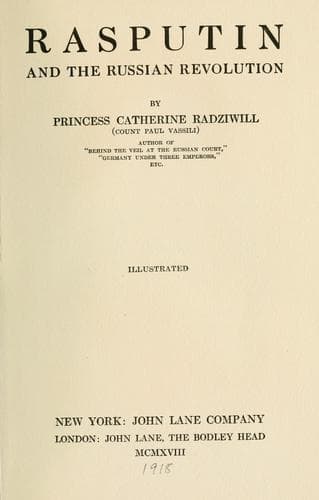
Rasputin and the Russian RevolutionRadziwill, Catherine, Princess
History
Rasputin and the Russian Revolution
Radziwill, Catherine, Princess
Rasputin, Grigorii Efimovich, 1869-1916; Soviet Union -- History -- Revolution, 1917-1921
This wholesale plundering, if I may be forgiven for using such a word,
was of course not the fault of Kerensky and of his colleagues, under
whose ministry it began, but whereas the latter realised immediately
that it was taking place and resigned rather than countenance it; the
former, though aware of it, found his hands tied in every attempt he
made to subdue it, by the fact that those who were principally guilty
were either his personal friends or his former partisans, or people
with whom he had associated in earlier times, and with whom he had
compromised himself to a considerable extent. With regard to those
associates of his former life, Kerensky found himself in the same
position as Napoleon III. after his accession, in presence of the
Italian Carbonari, who claimed from the Sovereign the fulfilment of
the promises made to them by the exiled Pretender. Kerensky had also
given certain pledges at a time when he never expected he might be
called upon to redeem them; and when he became a Minister he had to
give way to the exigencies of all the radicals, anarchists, and extreme
socialists among whom he had laboured, and with whom he had worked at
the overthrow of the detested and detestable government of the Czar. He
could not cast them overboard or set them aside. He had to listen to
them, and in a certain sense to submit to their demands. For example,
in the case of the exile to Siberia of the unfortunate Nicholas II.,
a measure which in the first days of the Revolution he had declared
that he would never resort to, but which he nevertheless executed
under conditions of the most intense cruelty, simply because it was
demanded from him by persons to whom he could not say no. People
who knew him well say that the fact of his powerlessness caused him
intense suffering, but he had neither the strength to assert himself in
presence of his former comrades, nor, perhaps, the will to do so.
In a certain sense, he was the man of the hour, “le maitre de l’heure,”
as the Franco-Arab proverb says. He was even to some extent the one
indispensable element without which it would have been impossible for
a Republic ever to become established in Russia. And everybody seemed
to agree, one year ago, that a Republic was the only form of government
possible after the fall of the Romanoffs. Of this Republic Kerensky
rapidly became the symbol and at the same time the emblem of a new
Russia; a regenerated and better one, in the opinion of his followers
of the moment; a worse one from what it had been formerly, in that of
his adversaries, but at all events of a different Russia from the one
previously known.
Public-domain text, read in full here on John Shaqi.
Reviews
Reviews
No reviews yet
Be the first to share your thoughts on this work.
Elsewhere in the archive
Join the Discussion
Join the discussion
Sign in to leave a comment or review.
Sign InorCreate an account