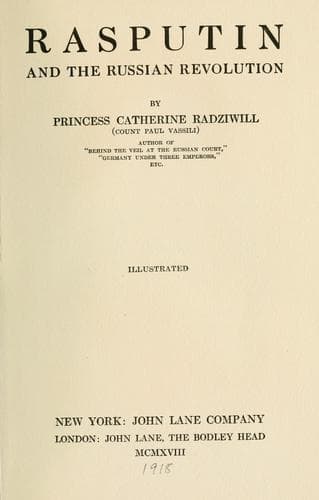
Rasputin and the Russian RevolutionRadziwill, Catherine, Princess
History
Rasputin and the Russian Revolution
Radziwill, Catherine, Princess
Rasputin, Grigorii Efimovich, 1869-1916; Soviet Union -- History -- Revolution, 1917-1921
If we are to believe all that we hear from people
who have arrived here from Russia recently, this movement of reaction
has already started, and it is bound to grow stronger with every day
and hour which goes by. The peace signed at Brest Litovsk will remain
verily a “scrap of paper” which will end by being thrown into the
waste-paper basket. Not one Russian will recognise it, not one Russian
will accept it; the Germans feel it themselves, and are preparing for
a new struggle which may have a far different conclusion from the one
which they are now trying to persuade the world has come to an end.
What has helped them, apart from the treason of Trotzky, Lenine and
their followers, who have only had one idea in heart and brain, that of
enriching themselves at the expense of the country for which they feel
neither affection nor pity, has been the state of confusion into which
Russia was thrown by the Revolution that broke up so unexpectedly--a
confusion which can only be compared to that which prevails in the
house of a man whom sudden ruin has overtaken, when every servant or
menial in the place tries to steal and take something in the general
disaster or to profit out of it in some way or other. In Petrograd, in
Moscow, as well as all over the country, looting took place, not only
of private property, but also of the Public Exchequer, especially of
the latter, and the Russian officials, who had always been grasping,
became all at once bandits after the style of Rinaldo Rinaldino, or
any other brigand illustrated by drama or comedy. They stole; they
took; they carried away; they seized everything they could lay their
hands upon. To begin with the silver spoons of the unfortunate Czar
and as many of the Crown Jewels as they could get hold of, down to the
paper money issued by the State Treasury, of which, as the Kerensky
government had to own before the so-called National Assembly at Moscow,
eight hundred millions were put into circulation every month after
the Revolution, in contrast with two hundred millions which were
issued formerly. I do not think that it is a libel on these officials
to suppose that part of this fabulous sum found its way into their
pockets, instead of being applied to the needs of the nation or of the
army.
Public-domain text, read in full here on John Shaqi.
Reviews
Reviews
No reviews yet
Be the first to share your thoughts on this work.
Elsewhere in the archive
Join the Discussion
Join the discussion
Sign in to leave a comment or review.
Sign InorCreate an account