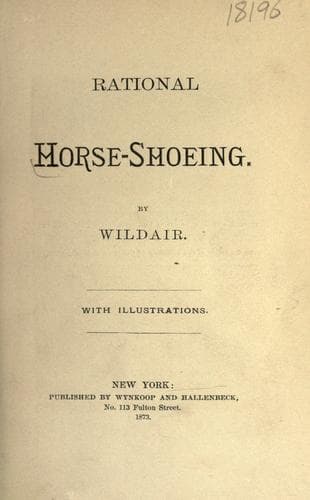
Rational Horse-ShoeingRussell, John E. (John Edwards)
Science
Rational Horse-Shoeing
Russell, John E. (John Edwards)
Horseshoeing
How quickly his active system responds to intelligent care and shows its
beneficial results! And when relieved from the abuses of ignorance, his
recuperative powers re-establish the springing step of youth.
CHAPTER I.
EVILS OF COMMON SHOEING.
Every horseman finds his chief difficulty in the fact that he has to
protect the natural foot from the wear incident to the artificial
condition in which the horse is placed in his relation to man. In those
important industries where great numbers of horses are used, and the
profit of the business depends upon the efficiency of the animal, the
question becomes a very serious one, and the life term of the horse, or
the proportion of the number of animals that are kept from their tasks
by inability, make the difference between profit and loss to the great
transportation lines that facilitate the busy current of city life. But
notwithstanding the importance of this subject, upon the score equally
of economy and humanity, the world is, for the most part, just where it
was a thousand years ago, possibly worse off, for the original purpose
of shoeing was only to protect the foot from attrition or chipping, and
but little iron was used, but, as the utility of the operation became
apparent, the smith boldly took the responsibility of altering the form
of the hoof to suit his own unreasoning views, cutting away, as
superfluous, the sole and bars, paring the frog to a shapely smoothness,
and then nailing on a broad, heavy piece of iron, covering not only the
wall but a portion of the sole also, thus putting it out of the power of
the horse to take a natural, elastic step.
In a short time the hoof, unbraced by the sole and bars, begins to
contract, the action of the frog upon the ground, which in the natural
foot is threefold--acting as a cushion to receive the force of the blow
and thus relieve the nerves and joints of the leg from concussion,
opening and expanding the hoof by its upward pressure, quickening the
circulation and thereby stimulating the natural secretions,--this all
important part of the organization, without which there is no foot and
no horse, becomes hard, dry, and useless. Then follows the whole train
of natural consequences. The delicate system of joints inclosed in the
hoof feel the pressure of contraction, the knees bend forward in an
attempt to relieve the contracted heel. In this action the use of the
leg is partially lost. The horse endeavors to secure a new bearing,
interferes in movement, or stands in uneasy torture.
Nature frequently seeks relief by bursting the dry and contracted shell,
in what is known as quarter or toe crack, and the miserable victim
becomes practically useless at an age when his powers should be in their
prime.
Public-domain text, read in full here on John Shaqi.
Reviews
Reviews
No reviews yet
Be the first to share your thoughts on this work.
Join the Discussion
Join the discussion
Sign in to leave a comment or review.
Sign InorCreate an account