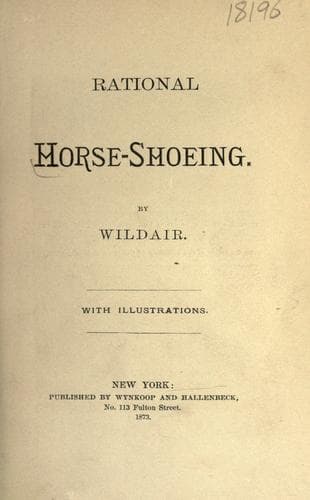
Rational Horse-ShoeingRussell, John E. (John Edwards)
Science
Rational Horse-Shoeing
Russell, John E. (John Edwards)
Horseshoeing
thin_; this must give us a bearing upon the frog and the sound part of
the foot. We use the lightest shoe, truly fitted with the rasp, not
burned on. The horse should then be worked regularly, and he will
experience at once the benefit of a return to "first principles" and
natural action.
[Illustration: FOOT, WITH SHELL REMOVED.]
CHAPTER V.
SIMPLE CASES OF CONTRACTION.
Contraction, in a greater or less degree, is exhibited by all horses, of
every grade, that have been shod in the common way, except in those more
unfortunate cases that have resulted in a breaking of the arch of the
foot, from lack of the natural frog support, when the phenomena of
"dropped sole" are found, and the usual accompaniment of "pumiced feet."
It may seem superfluous to say that the power and action of the horse
are greatly restricted by contraction.
The cartilaginous fibre that forms the bulk of the substance of the foot
behind the great back sinew is squeezed into narrow space, the working
of the joints compressed, and inflammation at the joints, or at the
wings of the coffin-bone, is excited; in worse cases navicular disease
is established, or, from inadequate circulation, thrush holds
possession at the frog, or scratches torment the heels.
When simple contraction--shown in the narrow heel, dried and shrunken
frog, and "pegging" motion of the horse--is the case, our design is at
once to restore the natural action of the foot. This must be done by
expansion, and that is to be had from frog-pressure, according to the
directions in the preceding chapters. If navicular disease has
commenced, and the animal is decidedly lame, we have a difficult case.
The membrane of this important bone, in some cases of contraction,
becomes ulcerated, and the bone itself may be decayed, or adhesion
between the coffin-bone and the navicular and pastern may take place.
Without expansion there is no possibility of relief; local bleeding,
poulticing, and all the drastic drugs of the veterinary will be invoked
in vain.
QUARTER AND TOE CRACK.
[Illustration: QUARTER CRACK--FULL SHOE.]
This disease, usually attributed to "heat," "dry weather," "weak feet,"
etc., is one of the common symptoms of contraction, and can be
entirely cured with the greatest ease; nor will it ever recur if the
hoof is kept in proper condition.
Public-domain text, read in full here on John Shaqi.
Reviews
Reviews
No reviews yet
Be the first to share your thoughts on this work.
Join the Discussion
Join the discussion
Sign in to leave a comment or review.
Sign InorCreate an account