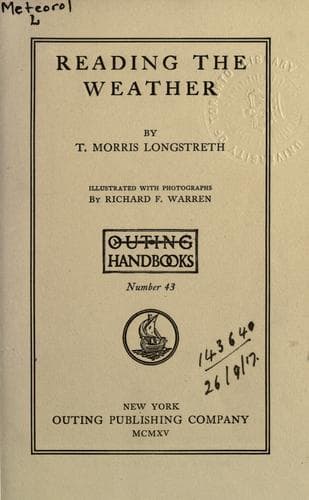
Reading the WeatherLongstreth, T. Morris (Thomas Morris)
Science
Reading the Weather
Longstreth, T. Morris (Thomas Morris)
Weather forecasting
In winter there is not such an opportunity offered and the few clouds that
form because of the daily variation in temperature are flatter and are
called stratus clouds. Sometimes these stratus clouds may cover the sky at
midday, but in thin platings and not leadenly. In winter as in summer they
tend to disappear toward evening. They are often accompanied by an
unpleasant wind, but rarely by the snow flurry which is the "April shower"
of the winter months.
But when the snow flurry does come there is no better sign for the
woodsman of coming cold; it never fails. The morning will have begun
brilliantly, but soon great summery puffs of cloud form and increase and
darken on their under sides. Their tops are vague and wear a veil. It is
the snow. The reason is simple. The coming anticyclone strikes the upper
air before it hits the earth's surface. The sudden cold causes rapid
condensation. Hence the flurries. But the anticyclone is an agent of
dryness, hence their short duration. Sometimes the veil of snow does not
reach the earth. Sometimes it blots out everything in a spirited squall.
But it never lasts long, except in the northwest states. And it is
invariably followed by a period of colder weather.
In summer local evaporation may be so long-continued or so vigorous that
the cumulus clouds cannot hold all their moisture content when cooled. A
shower is the result, usually a trifling one and mostly without thunder.
The great thunderstorms are always in connection with the passing of a
cyclone. The small heat thunderstorms are only the indulgences of a spell
of fair weather. These tiny showers are daily and sometimes hourly
accompaniments of clear weather in the mountains. The air warms rapidly in
the valleys and is speedily cooled on rushing up a mountain side and a
threat and a sprinkle are the result. When a performance of this sort is
going on nobody need fear unpleasant weather of long duration.
Another pledge of a clear day that does not appear too credible on the
face of it is the morning fog in summer. In winter it is a different
matter. In August and September particularly the rapidly lengthening
nights allow so much heat to evaporate that the surplus moisture in the
air is condensed to the depth of several hundred feet. By ten o'clock the
sun has eaten into this lowest stratum, heated it and yet begins to
decline in power before the balance swings the other way, so that a
cloudless day often follows a fog in those months. About three mornings of
fog, however, are enough to discourage the sun and a rain follows. Of
course this is because the anticyclone with its special properties has
been losing power.
When these conditions of clear nights with no wind follow the first two or
three windy days of the anticyclone, particularly in autumn and spring,
frost results. In winter the chances that a fog will be dissipated are
rather slim. But if it shows a tendency to rise all may yet be well.
Public-domain text, read in full here on John Shaqi.
Reviews
Reviews
No reviews yet
Be the first to share your thoughts on this work.
Join the Discussion
Join the discussion
Sign in to leave a comment or review.
Sign InorCreate an account