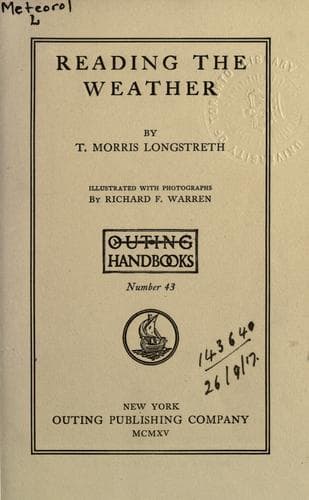
Reading the WeatherLongstreth, T. Morris (Thomas Morris)
Science
Reading the Weather
Longstreth, T. Morris (Thomas Morris)
Weather forecasting
If the dust and water particles grow so large and numerous as to divert
more of the short rays than usual we get a redder glow than usual. This is
most noticeable when the sun and clouds are near the horizon for the air
through which they appear is nearer the earth and consequently dirtier. If
these water globules mass together so as to reflect all the rays alike the
result is a whitish appearance. That is why a fog bank, composed of tiny
droplets, each reflecting with all its might, can make the sky a dull and
uniform gray.
As evening approaches the temperature of the normal day lowers. As the
temperature lowers it is the tendency of the moisture in the air to
condense about the little dust particles in the air. And as these
particles increase in size their tendency is to reflect more and more of
the waning rays of light. Therefore if the sky is gray in the evening it
means that the atmosphere already contains a good deal of condensed
moisture. If the cooling should go on through the night, as it normally
would, condensation would continue with rain as the likely result.
If, on the other hand, after the evening's cooling has progressed and yet
the colors near the horizon are prevailingly red it means that there is so
little moisture in the atmosphere that the further increase due to the
night's condensation will not be sufficient to cause rain. Hence the
natural delight of the sailor.
A gray morning sky implies an atmosphere full of water precisely as an
evening gray does. The difference lies in the ensuing process. By morning
the temperature has reached its lowest point and if this has not been
sufficient to cause cooling to the rainpoint the chance for rain will be
continually lessened by the growing heat of the rising sun. The gray,
therefore, is the normal indication of a clear cool night which has
permitted radiation and therefore condensation to this degree. It is for
this reason that we have the heavy fogs of August and September followed
by cloudless days.
A red morning sky shows, like the red evening sky, that condensation has
not taken place to any extent. But this is abnormal for a clear night
causes condensation. The red therefore means that a layer of heavy moist
air above the surface levels has prevented the normal radiation. Hence
when the day's evaporation adds more moisture to that already at the
higher levels the total humidity is likely to increase beyond the dewpoint
with the resultant rain.
Public-domain text, read in full here on John Shaqi.
Reviews
Reviews
No reviews yet
Be the first to share your thoughts on this work.
Join the Discussion
Join the discussion
Sign in to leave a comment or review.
Sign InorCreate an account