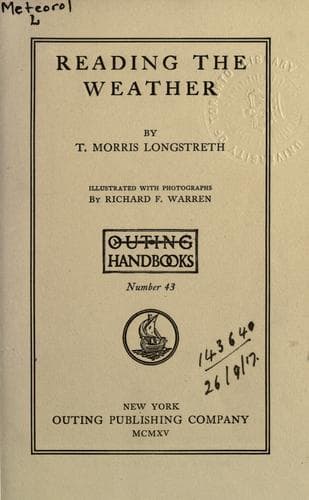
Reading the WeatherLongstreth, T. Morris (Thomas Morris)
Science
Reading the Weather
Longstreth, T. Morris (Thomas Morris)
Weather forecasting
But perhaps the upward rush of warm, moist air has been so great in the
morning that the afternoon cooling cannot dispose of it all without
spilling. Then occurs a little shower,--the April sort. Often in our
mountainous districts it showers every day for this reason. The great
thunderstorms come for greater reasons: they are yoked to a low pressure
area and represent the summer's brother to the winter's three-day storm.
Cumulus clouds are called fair weather clouds until their bellies swell
and blacken and they begin to form a combination in restraint of sunlight.
Even then it will not rain so much out of the blackness as out of the
grayness behind it, and if there is no grayness chances are that you will
escape a wetting. One can almost always measure the amount of rain that is
imminent by the density of the curtain being let down from the rear of the
cloud. If you can see the other clouds through it or the landscape the
shower will be slight. If a gray curtain obscures everything behind it you
had better pull your canoe out of the water and hide under it if time is
less valuable than a dry skin. Such showers may be successive but rarely
continuous.
Rain clouds have been observed within 230 yards of the ground. Very often
it can be seen to rain from lofty clouds and the fringe of moisture
apparently fail to reach the earth, because the condensation was licked up
and totally absorbed on entering a stratum of warmer air. The reverse of
this occurs on rare occasions;--condensation takes place so rapidly that a
cloud does not have time to form, and rain comes from an apparently clear
sky. This phenomenon has been witnessed oftenest in dry regions and never
for very long or in great amounts, although a half hour of this sort of
disembodied storm is on record.
If the cumulus clouds of the summer's afternoon do not decrease in size as
evening approaches showers may be looked for during the night. And if the
morning sky is full of these puffy little clouds the day's evaporation on
adding to them will probably cause rain. A trained eye will distinguish
between a stale and fresh appearance in cloud formation, the light, newly
made, fresh clouds, like fresh bread, contain more moisture. If the clouds
have much white about them they need not be feared as rain-bearers. Clouds
are much higher in summer than in winter and the raindrops of warm air are
larger than those of cool.
Public-domain text, read in full here on John Shaqi.
Reviews
Reviews
No reviews yet
Be the first to share your thoughts on this work.
Join the Discussion
Join the discussion
Sign in to leave a comment or review.
Sign InorCreate an account