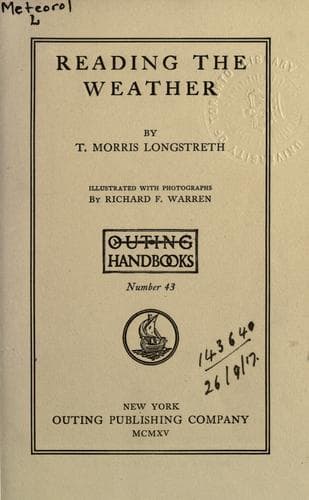
Reading the WeatherLongstreth, T. Morris (Thomas Morris)
Science
Reading the Weather
Longstreth, T. Morris (Thomas Morris)
Weather forecasting
If the wind shows a tendency to edge around to the southeast there is
danger of the snow turning to rain; if the wind veers slowly to the
northeast the temperature will fall slowly and the rate of precipitation
will likely increase for a while. In such instances the snow does not
continue to fall after the wind has swung west of north. Often clearing
takes place with the wind still in the north or even a point east of
north.
Contrary to superstition snow may begin to fall at any hour of the day or
night. But certain hours seem more propitious than others, owing no doubt
to the tendency of cooling air to condense. Three o'clock of an afternoon
and eight o'clock in the morning are favorite times, the one being the
hour of a winter afternoon when cooling is begun, the other the hour when
the coldest time is reached and condensation likely if at all. Of course,
one remembers storms beginning at nine, ten, eleven, and every other hour.
Storms that begin in the morning seldom reach much activity before three
o'clock in the afternoon, while those that begin then quickly increase in
intensity as evening draws near and the sun's warmth is withdrawn from the
upper air-strata. More snow falls at night than in the daytime, also. Snow
is more delicate than rain and perhaps more responsive than rain to the
subtle changes of the atmosphere. Possibly there is no ground on the
Bureau records for these ideas, possibly storms have a tendency to start
from the Gulf on their northeastward journey and so reach Philadelphia
oftener at one time than another. I would like my notions confirmed that
snowstorms increase at nightfall, and that they prefer to start operations
at sunrise and about sunset.
For the camper the snowstorm need have no terrors. It gives a long warning
of its approach. It comes mostly without destructive winds. Its upholstery
protects and warms the walls of one's tent. It adds beauty to the leafless
woods, interest to the trailer, and a hundred amusements among the hills.
But the value of snowy weather is not only measured by its beauties and
commercial uses. There is another way: make it read character for you.
Watch the reactions toward the first snowfall of half a dozen kinds of
people. It will show you what they are; give you a very fair measure of
their youth.
Our atmosphere contains a lot of moisture that never gets precipitated.
You can prove this on any warm day by noticing the way the atmosphere acts
toward a glass of ice-water. When the air of the room is much warmer than
the surface of the glass it surrenders its moisture willy nilly. Sometimes
this condensation is enough to cause a miniature rainstorm that trickles
down the outside of the tumbler. If a small cold surface can wring so much
water out of a little air it is small wonder that we get an inch or so of
rain from vast currents of air at unequal temperatures.
Public-domain text, read in full here on John Shaqi.
Reviews
Reviews
No reviews yet
Be the first to share your thoughts on this work.
Join the Discussion
Join the discussion
Sign in to leave a comment or review.
Sign InorCreate an account