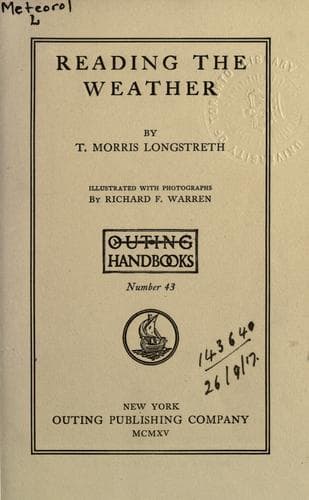
Reading the WeatherLongstreth, T. Morris (Thomas Morris)
Science
Reading the Weather
Longstreth, T. Morris (Thomas Morris)
Weather forecasting
Hail is frozen rain. Winter hail is small and harmless and rarely falls to
any depth because the exact temperatures that bring forth the hail rarely
continue for very long at a time. Hail in winter is merely the stepping
stone to either rain or snow. But in summer hail is a serious matter. It
shows that there is a violent disturbance of the atmosphere in progress.
Vertical air currents, probably abetted by electricity,--the authorities
are not sure--often carry the stones up several times. They take on layer
after layer, coalesce, and sometimes fall the size of eggs, apples, or any
other fruit, barring melons. The usual summer hail does not exceed the
size of a robin's egg. Even a projectile of that size, however, falling
for a half mile or more has a tremendous destructive power. Greenhouses
suffer, birds are killed, cattle stunned, and loss of life has been known
to follow. In August in 1851 in New Hampshire hailstones fell to the
weight of 18 ounces, diameter 4 inches, circumference 12 inches. In
Pittsburgh stones weighing a full pound have crashed down, and in Europe
where many destructive storms have occurred there are official records of
even greater phenomena. The lightning accompanying these hailstones is
usually very severe. A flake or ball of snow forms the nucleus of a
hailstone.
If a thundercloud looks particularly black or if it can be seen in
commotion think of hail and seek shelter. It is pretty difficult to
predict exactly when hail is going to fall in summer. It is a possibility
with every large storm, but a probability with only a very few during the
summer. It accompanies tornadoes.
In winter hail falls before a rainstorm, even when the ground temperature
precludes the possibility of snow; some lingering stratum of cold air has
ensnared the drops on their way down.
Snow is not frozen rain. It has an origin of its own. It is born in a
temperature consistently below freezing and on the condensation of the
invisible moisture becomes visible as a tiny crystal. These infinitesimal
crystals unite and form larger, hexagonal shapes, elongated or starry.
They are wafted along, sinking, all slightly differing one from another,
although forming a few types. These types have been photographed and
catalogued and very often the altitude from which the snow is coming may
be learned from their shape and design. But this branch of science is
young yet and confusing and the outdoor man has surer signs of the
vicissitudes of the storm, in the general size of the flakes, the power
and direction of the wind, the clouds and temperature. The possibilities
of flake-study as a means of forecasting are many and of value as is
anything that tends to unveil the secrets of the greater heights.
Snowflakes are so light that after the storm processes are over and the
sun has come out the residue may still float lazily to the ground.
The wild disorder of the snow flurry will only last a few minutes and
never leave much snow on the ground.
Public-domain text, read in full here on John Shaqi.
Reviews
Reviews
No reviews yet
Be the first to share your thoughts on this work.
Join the Discussion
Join the discussion
Sign in to leave a comment or review.
Sign InorCreate an account