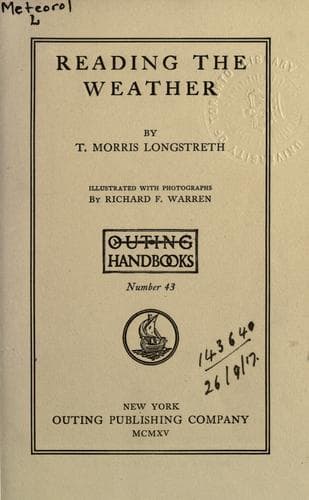
Reading the WeatherLongstreth, T. Morris (Thomas Morris)
Science
Reading the Weather
Longstreth, T. Morris (Thomas Morris)
Weather forecasting
Bees localize before a storm and will not swarm. Flies crowd upon the
screens of houses when humidity is high, possibly because the appetizing
odors from within are buoyed afar by the heavy air. Cuckoos seek the
higher ground in fair weather and disappear into bottom lands before a
rain. Although they are called rain-crows they are heard in all weathers.
Smoke is as good an evidence of barometric pressure as anything except the
instrument itself. On clear, still days it will mount; on humid days
without wind it will cling to the hill. There is that difference. But it
takes skill and many comparisons to gauge its angles in the wind. It
becomes a test in observation and finally rewards one by becoming an
excellent sign not only of air texture but of the direction of its
currents.
No reference to barometers would be complete without mentioning spiders.
They show a most delicate apprehension of changing conditions. If the day
is to be fine and without wind they will run out long threads and be
rather active. If the rain is nearing they strengthen their webs, shorten
the filaments and sit dully in the center. Fresh webs on the lawn insure
a clear day. But for the commuter, whose time is money, there is little
leisure to consider the spider.
As a natural result of the variation in altitude affecting the barometer
the words which are printed on the face become entirely useless. In some
places it would be impossible for the needle to point higher than "Very
Stormy." Even at sea level a sudden fall to "Fair" would cause a rain,
much to the indignation of the person who thought that he had purchased a
self-registering weather prophet. Disregard the words but watch the needle
and you will never be surprised at what the weather is doing next.
CHAPTER VI
THE SEASONS
Too great emphasis cannot be laid upon the futility, at present, of trying
to forecast the weather for more than a very few days in advance. Long
range efforts are not made by the Bureau because with its present limited
knowledge of the factors that control seasons and with the present limited
facilities for collecting data the process of looking into next month has
not been perfected, and the attempt to investigate next winter's weather
proves scientifically impossible.
Public-domain text, read in full here on John Shaqi.
Reviews
Reviews
No reviews yet
Be the first to share your thoughts on this work.
Elsewhere in the archive
Join the Discussion
Join the discussion
Sign in to leave a comment or review.
Sign InorCreate an account