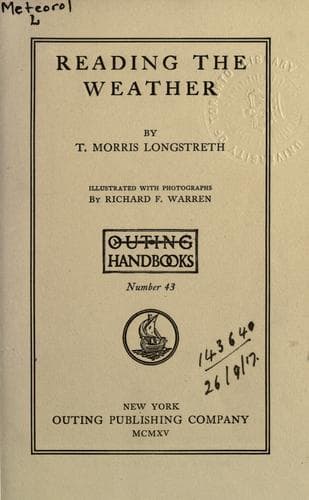
Reading the WeatherLongstreth, T. Morris (Thomas Morris)
Science
Reading the Weather
Longstreth, T. Morris (Thomas Morris)
Weather forecasting
As usual, fakers step in where science fears to tread. With goose-bones
(not their own) and hickory nuts they prophesy with all their might. And
if their prophecies come true, as sometimes they must, there is wide
rejoicing in the newspapers and the cause of science is set back by just
so much. But science cannot be thwarted in the end and every year new
discoveries are made, new speculations proved true or forever false, and
some time, doubtless, the weather will be predicted from year to year
with the same 85% accuracy with which the 36 hour forecast is now made.
Experimenting is worth the little that it costs, too, for to know when the
summer is to be dry or wet, hot or cold will be a boon to everybody and to
the farmer most of all.
One conclusion has already been reached by officials in the Weather Bureau
and scientists generally. It has been decided by long search through
creditable records, painstaking comparisons of averages coupled with the
most accurate investigations for half a century, that, on the basis of ten
years, our seasons do not change. That is, counting the decade as a unit,
our weather keeps to the same level of efficiency through the centuries.
This statement comes always as a blow. It always provokes argument and
citations of grandmother's blizzards. There is a great and universal
hesitation in believing that our weather is as good to-day as it used to
be. The good old times when there was a general debauch of snow and you
could skate all winter on anything but the Atlantic Ocean certainly appear
no more. As a matter of fact there has been a change, but it has been in
our memories. In grandmother's youth the trains,--if they had trains
then,--doubtless were stalled by a big snow for then they did not have
rotary plows. In father's day they may have had an unbroken winter of
sleighing. We couldn't now; sleighs are extinct. But in our time, in fact
every year, some record is being broken and the records go back a
respectable length of time.
For example in Philadelphia the most accurate records made by standard
instruments have been kept for 43 years. During this time the highest wind
velocity was recorded in 1878 (75 miles an hour). The greatest rainfall in
24 hours occurred in 1898 (5.89 inches). The lowest temperature was
registered in 1899 (6 degrees below zero); the highest in 1901 (103
degrees). The greatest number of thunderstorms for any one year took place
in 1905 when we had 51. As late as 1909 the heaviest snowfall ever
recorded at this station, amounting to 21 inches, occurred. And just a few
weeks ago (April 3rd, 1915) it snowed 19 inches in half as many hours. All
these items do not indicate a climate decreasing in virility very swiftly.
Public-domain text, read in full here on John Shaqi.
Reviews
Reviews
No reviews yet
Be the first to share your thoughts on this work.
Elsewhere in the archive
Join the Discussion
Join the discussion
Sign in to leave a comment or review.
Sign InorCreate an account