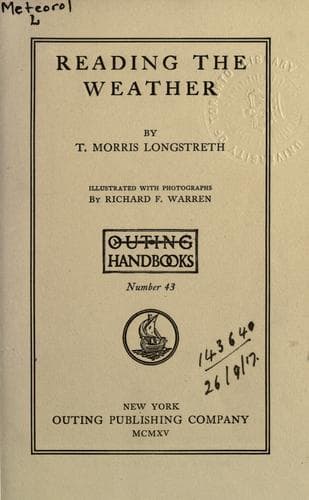
Reading the WeatherLongstreth, T. Morris (Thomas Morris)
Science
Reading the Weather
Longstreth, T. Morris (Thomas Morris)
Weather forecasting
But there is more evidence yet that Philadelphia is experiencing the same
varieties of weather in about the same proportions. Diaries of observant
men running back to 1700 show that almost any kind of memory could be
founded on fact, that the same violent changes in temperature, the same
deep snows and unseasonable seasons that we endure to-day were noticed
then. To quote:
"The whole winter of 1780 was intensely cold. The Delaware was closed from
the 1st of December to the 14th of March. The ice was from two to three
feet thick." We despaired of ever living up to this until three years ago
when the same thing happened and sleighs crossed the river a little above
the city. And despite the new ice-boats!
"The winter of 1779 was very mild, particularly the month of February when
trees were in blossom."
"On the 31st of December, 1764, the Delaware was frozen completely over in
one night, and the weather continued cold until the 28th of March with
snow about two and a half feet deep."
"The winter of 1756 was very mild. The first snow was as late as the 18th
of March."
And so it goes. 1750 was mild; 1742 "one of the coldest since the
settlement of the country"; 1741 was intensely cold, 1725 mild, 1714 very
mild after the 15th of January, 1697 long, stormy and severely cold. The
upshot of it all is that February violets and April snows were just as
well known to General Washington as they are to us.
[Illustration: NIMBUS
_Courtesy of Richard F. Warren_
Nimbus is any cloud from which rain is falling, and the important thing to
know is how to judge from the formless thing how much longer it is to
rain. The wind is the surest guide. In this picture the nimbus cloud is
only that at the end of the cape. All the rest is torn stratus and
cumulus, which needs to condense a little further before it becomes
nimbus. This will likely happen because the cloud at the left is very
dark. The broken appearance denotes some wind. Rain does not fall from a
mottled sky nor yet a streaky one; the nimbus is uniform in appearance. In
summer a break in the nimbus will show a veil of cirro-stratus above. Just
nimbus by itself will not support much of a storm. In winter if the nimbus
is particularly seamless snow is about to fall.]
But though all facts point to the fact that the climate does not change in
a decade or a generation or a dozen generations, there is some comfort for
those who are not satisfied in knowing that it doesn't stay the same
forever. During the carboniferous times the poles were as warm as the
tropics and when the Ice Age came on it was very chilly everywhere. If one
might only live an eon or two he might then well complain of the changing
climate.
Public-domain text, read in full here on John Shaqi.
Reviews
Reviews
No reviews yet
Be the first to share your thoughts on this work.
Elsewhere in the archive
Join the Discussion
Join the discussion
Sign in to leave a comment or review.
Sign InorCreate an account