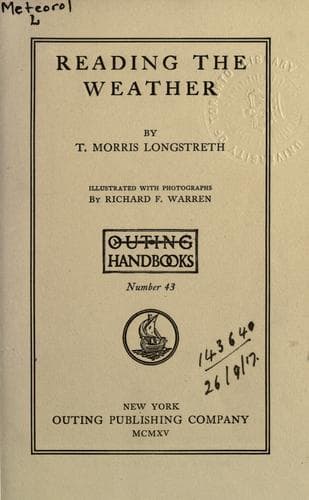
Reading the WeatherLongstreth, T. Morris (Thomas Morris)
Science
Reading the Weather
Longstreth, T. Morris (Thomas Morris)
Weather forecasting
In the good old times when a man was born, spent his life, and died in the
same village the weather proverb was fashioned. Generations had watched
the clouds gather under certain circumstances and scatter under certain
others and they naturally drew conclusions. These conclusions crystallized
until they resembled nuggets of golden weather wisdom. Some were even used
as charms. And all contained a deal of truth so long as they were only
meant to refer to the country in which they had originated.
But nowadays when the very idea of remaining in the same place for very
long at a time is obnoxious the weather proverb suffers. It suffers
chiefly by transportation. The weather in County Cork is so very different
from the weather that makes Chicago famous that the same weather lore does
not fit. Yet it is often applied. The old truths, treasured in picturesque
phrase and jingle, were brought over the ocean unchanged and made to do
duty,--a case of new wine in old bottles again, for a gentle old Irish
proverb splits up the back when it tries to accommodate itself to a week
of our reckless but magnificent weather.
Fairy stories are jewels to be cherished. And it is a careless and
unimaginative race that perpetuates no legends. Even old saws are quaint
and should be preserved: "See a pin and pick it up, all the day you'll
have good luck." Let that sort of thing go on because it adds richness to
our conversation. But if a thousand men, after having picked up their
morning pins, sat around waiting for the ensuing luck the progress of
scientific business management would be halted. And precisely that way is
the knowledge of ordinary weather facts halted,--a full-grown superstition
sits in the path. Instead of relying upon their eyes the majority of
people rely upon a bit of doggerel. For example, millions of people firmly
believe that the ground-hog is a key to the weather. They say that if the
ground-hog does not see his shadow on the 2nd of February that winter is
over!
This is the sort of thing that obscures the findings of science not to
mention common-sense. Few of these people have ever seen a ground-hog.
Few of the rest have ever studied its habits. The ant, the mouse, the fly,
the rat, and the mosquito have far more influence upon our lives than the
ground-hog has and the most ambitious animal cannot expect to influence
atmospheric pressure, which is responsible for our weather. Yet as often
as the 2nd of February comes around the hopes of many are either dashed or
raised according to the actions of this creature. As a matter of fact,
whether February 2nd is clear or cloudy can have no influence on the rest
of the winter.
Public-domain text, read in full here on John Shaqi.
Reviews
Reviews
No reviews yet
Be the first to share your thoughts on this work.
Elsewhere in the archive
Join the Discussion
Join the discussion
Sign in to leave a comment or review.
Sign InorCreate an account