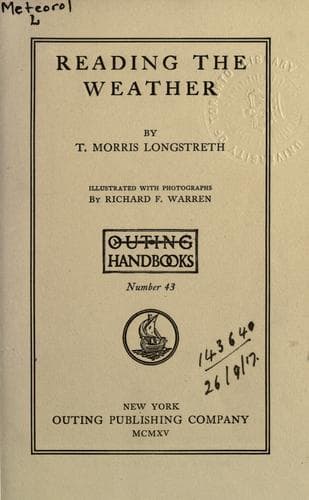
Reading the WeatherLongstreth, T. Morris (Thomas Morris)
Science
Reading the Weather
Longstreth, T. Morris (Thomas Morris)
Weather forecasting
Almost all the other proverbs have a basis of reason. But this puts its
believers in the wrong either way. If they say that it is the actions of
the animal that they rely upon they depend upon a characteristic
thoroughly and surely disproved. No animal, although it may sense a change
in the weather a few hours in advance, is able to feel it for three days
ahead to say nothing of six weeks. If these people say, on the other hand,
that a cloudy February 2nd means an immediate and complete let up of
winter, or that a clear February 2nd means a certain continuance of cold
weather for six weeks, they have only to trouble themselves to look at the
files of the nearest Weather Bureau for the last forty years. They will
find no connection. The trouble is that they will not look, but keep on
repeating the bit of nonsense and believing in it, although the strength
of their convictions probably does not reduce their coal-bills.
The same people are fond of saying that the first three days of December
show what the winter will be like. That is, if the 1st is fair so will
December be; if the 2nd is cold so will January be; and if it snows on the
3rd, so will it snow in February. If all three should be clear and warm
certainly a remarkable winter would follow! No rain, no snow, no cold! You
see how absurd this superstition is.
"A dry moon lies on its back!" After the ground-hog the moon is supposed
to have the most influence on our seasons. The Government and many
scientists connected with no governments have made careful, exhaustive and
conclusive investigations. No relation between the moon and our weather
has been discovered except as she causes our tides and they affect
atmospheric pressure in an infinitesimal degree. We would still have just
as much and just as variable weather if there were no moon. The weather
changes with the changing moon, and it does not change as the moon
changes, and the chances are about even that the times of change will
coincide. So there is, therefore, absolutely no foundation for the dozens
of proverbs that yoke the changes of the moon with the changes of our
weather. Neither in science nor in observation has any sequence been
deduced.
So the moon may lie on its back or on its side or stand on its head and
the weather will remain dry if no low pressure areas cross the country,
and it can lie on its back for days and the country be drowned out if they
do. There are enough pretty things to say about the moon, anyway, and will
be more all the time for, to commit a paraphrase: Science is stranger than
superstition.
Public-domain text, read in full here on John Shaqi.
Reviews
Reviews
No reviews yet
Be the first to share your thoughts on this work.
Elsewhere in the archive
Join the Discussion
Join the discussion
Sign in to leave a comment or review.
Sign InorCreate an account