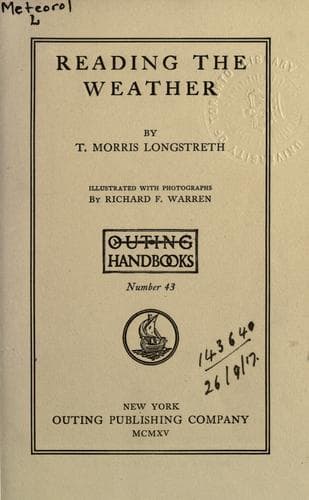
Reading the WeatherLongstreth, T. Morris (Thomas Morris)
Science
Reading the Weather
Longstreth, T. Morris (Thomas Morris)
Weather forecasting
"It will rain for forty days straight if it rains on St. Swithin's Day,"
which, I might as well say for the benefit of those who don't know their
saints, falls on July 15th every year. It would be interesting to know how
many people in a hundred really believe this, or really believe all the
other things that are attributed to the saints,--quite a few, probably.
Luckily for St. Swithin July and August are wet months, with often several
days of showers or thunderstorms in succession. But never once in
Philadelphia has it rained for forty days, one right after another,
although half the July 15ths have been rained on. This proverb is one of
those that had better never been transplanted from its native Ireland
where rain for 40 days would excite scarcely a curse.
"Long and loud singing of robins denotes rain." It does not. Oftener than
not it denotes the time of day. Just watch the robins and listen to them
and see what they do before a storm, during it, after it, and then you
will see how little the songs of birds can be depended upon to supplant
the barometer.
"If March comes in like a lion it will go out like a lamb," and the other
way round. I have seen March come in like a lion and go out like a lion,
come in like a lion and go out like a lamb, come in like a lamb and go out
like a lion, and come in like a lamb and go out like a Noah's ark. But I
never have seen March do anything dependable. It is quite impossible to
tell how March is going out on March 27th, and absolutely impossible to
tell on March 1st.
But there is this much observation expressed in the proverb, that March is
so changeable that, if it comes in cold, windy, unsettled, there is not so
much chance for such weather still to be going on at the end of the month,
and still less in England where the proverb came from. This is a harmless
proverb unless it should lead people to actually count upon a pleasant
spring just because March had an unpleasant inception. Misfortunes rarely
come singly, even on the weather calendar.
"When squirrels are scarce in autumn the winter will be severe." Aside
from the scientific truth that the animals cannot know in advance about
the seasons there is little evidence on either side to base a contention.
Nobody has made a squirrel census; nobody, probably, has found out whether
they increase in numbers for six years and then die off in great
quantities as do the rabbits in the north country on the seventh; nobody
has connected their apparent numbers year after year with the actual
severities of the winters. And so nobody has a right to promulgate the
report (except as a bit of nonsense like April Fool) that the ensuing
winter is going to be a record breaker because the squirrels have
disappeared. It would be far truer to say that "When squirrels are scarce
in autumn the hunters have been busy," and let it go at that.
Public-domain text, read in full here on John Shaqi.
Reviews
Reviews
No reviews yet
Be the first to share your thoughts on this work.
Elsewhere in the archive
Join the Discussion
Join the discussion
Sign in to leave a comment or review.
Sign InorCreate an account