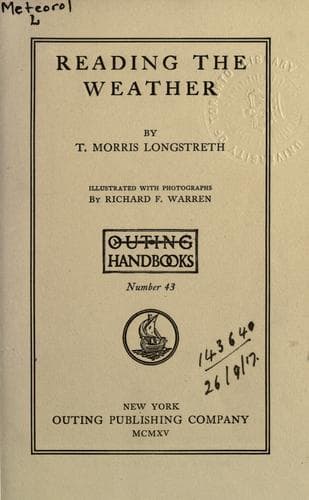
Reading the WeatherLongstreth, T. Morris (Thomas Morris)
Science
Reading the Weather
Longstreth, T. Morris (Thomas Morris)
Weather forecasting
The blue sky has a tendency to show green near the northern horizon
(colder).
The sun breaks through a departing thunderstorm and makes a rainbow.
Snow-flurries drift down a north wind (colder).
Cirrus clouds, or others, dissolve, or cirrus have tails down.
Spiders spin on the grass.
There is a moderate dew or frost.
The temperature is normal or colder than normal, other signs being right.
The sky is sown with stars.
The moon rises clear.
The wind blows down mountain ravines after nightfall.
The salt is dry, smoke ascends, birds fly high, and animals act normally.
The barometer rises slowly, or is steady at or above 30.00.
No change need be feared as the anticyclone nears, or for three days after
clear conditions are established so long as the wind remains brisk from
some westerly quarter. The direction of the wind, the kind of cloud, and
the temperature changes are the factors to watch if you have no barometer.
* * * * *
Look for a change toward storms when:
The west wind suddenly drops.
The west wind shifts to south or northeast.
The cirrus clouds appear in well-organized lines.
The cirrus clouds merge into cirro-stratus.
The sky looks like fish scales, so-called mackerel sky.
Light scud drifts across the sky from east to west.
The summer cumulus clouds increase in size as the afternoon proceeds.
Walls grow damp, flies are more of a burden than usual, swallows fly low.
Smoke falls to the ground.
There have been three white frosts.
A halo appears around either the moon or sun.
When sun-dogs appear about the sun, denoting ice-particles in the air.
The summer morning is sultry and the wind variable.
The temperature is much above the normal.
Few stars are visible and those are indistinct. The clouds gather about
the mountain tops, or drop down the mountain-sides.
The wind continues to blow up ravines after nightfall.
The sunset is a dull gray, or the sun sets into a livid cloudbank.
The sunrise is a fiery red, and the dawn is high.
The sun gradually is smothered in fine-textured clouds and the wind
shifts.
The temperature does not fall at night.
The signs most to be heeded are the shift of wind to a point east of
north or south, the gradual filming of the sky with cirrus and
cirro-stratus, and the increase of temperature. Of course, the barometer
is the best indicator of all.
* * * * *
Look for a change toward clearing when:
The wind shifts from the easterly quarter into the west.
The temperature falls rapidly.
The clouds rise, or break, or lighten perceptibly in color.
Patches of blue sky appear through the rifts in the clouds, wind north.
Raindrops grow smaller after the windshift.
Snowflakes drive less busily, float lazily down, or thin out
conspicuously.
Seams appear in the clouds, snow will cease and rain probably.
The thunder and lightning occur only in the eastern quarter.
Public-domain text, read in full here on John Shaqi.
Reviews
Reviews
No reviews yet
Be the first to share your thoughts on this work.
Elsewhere in the archive
Join the Discussion
Join the discussion
Sign in to leave a comment or review.
Sign InorCreate an account