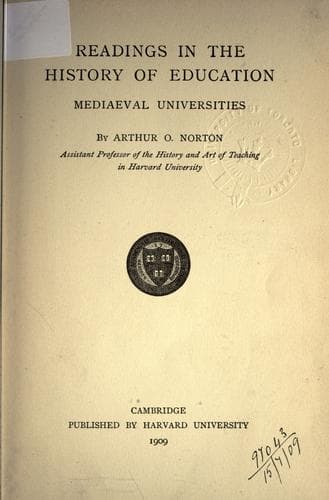
Readings in the History of Education: Mediaeval UniversitiesNorton, Arthur O.
History
Readings in the History of Education: Mediaeval Universities
Norton, Arthur O.
Education, Medieval -- History -- Sources; Universities and colleges -- Europe
_Isidore, Etymologiae, Bk. XVIII, ch. iii:_ A righteous war is
one waged according to orders, to recover property or drive back
the enemy.
_Pope Nicholas to the questions of the Bulgarians:_ If there is
no urgent need, not only in Lent but at all times, men should
abstain from battles. If however there is an unavoidable and
urgent occasion, and it is not Lent, beyond all doubt
preparations for wars should be sparingly made in one's own
defence or in that of one's country or the laws of one's fathers;
lest forsooth this word be said: A man if he has an attack to
make, does not carefully take counsel beforehand for his own
safety and that of others, nor does he guard against injury to
holy religion.[9]
This example shows the scholastic method in its earliest form,--the
statement of the thesis, followed by the simple citation of authorities,
_pro_ and _con_. Later writers added the conclusion which they wished to
support, or at least indicated it in the statement of the thesis. This,
of course, robbed the method of much of its stimulus to independent
thinking. Other modifications also appeared. See the examples on pages
58 ff., 121 ff. The point to be noted here is that in the "Yes and No"
Abelard struck out definitely the method which was followed for
centuries in a large part of university instruction. How great a part it
played can be understood only by an extended study of university
history. A brief discussion of the subject is given on pages 35-37. The
stimulating way in which Abelard used it was potent in drawing students
to Paris. Among those who came to hear him was John of Salisbury.
(b) _A Pre-University Scholar: John of Salisbury_
John of Salisbury (c. 1120-1180), "for thirty years the central figure
of English learning," "beyond dispute the best-read man of his time," is
a good example of the more serious students among those who travelled
abroad for study in the early days of the revival described above. He
spent twelve years (1136-1148) at Paris and at Chartres. His
"Metalogicus" (completed about 1159) is perhaps the best contemporary
account of educational affairs in France in the twelfth century.
Public-domain text, read in full here on John Shaqi.
Reviews
Reviews
No reviews yet
Be the first to share your thoughts on this work.
Join the Discussion
Join the discussion
Sign in to leave a comment or review.
Sign InorCreate an account