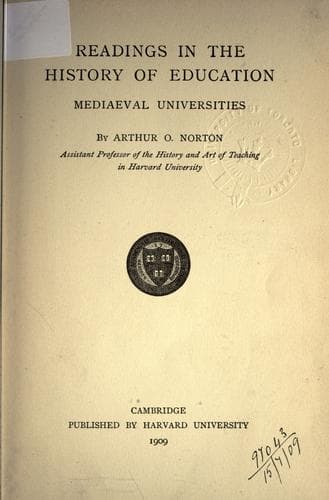
Readings in the History of Education: Mediaeval UniversitiesNorton, Arthur O.
History
Readings in the History of Education: Mediaeval Universities
Norton, Arthur O.
Education, Medieval -- History -- Sources; Universities and colleges -- Europe
With these teachers I remained two years, and got so versed in
commonplaces, rules, and elements in general, which boys study,
and in which my teachers were most weighty, that I seemed to
myself to know them as well as I knew my own nails and fingers.
There was one thing which I had certainly attained to, namely, to
estimate my own knowledge much higher than it deserved. I thought
myself a young scholar, because I was ready in what I had been
taught.
Evidence external to this narrative shows that he now went to the school
at Chartres,--some sixty miles southwest of Paris,--which was one of
three great French schools of the period (see p. 10). During the first
half of the twelfth century it became famous under the teaching of the
brothers Theodoric and Bernard Sylvester, who are both mentioned in the
following passages. The school was distinguished in particular for its
devotion to Grammar, Rhetoric, and classical Latin literature; in this
respect it was in marked contrast to Paris, where Logic and Theology
were the prevailing studies.
I then, beginning to reflect and to measure my strength, attended
on the Grammarian William de Conches during the space of three
years; and read much at intervals: nor shall I ever regret the
way in which my time was then spent. After this I became a
follower of Richard l'Eveque, a man who was master of every kind
of learning, and whose breast contained much more than his tongue
dared give utterance to; for he had learning rather than
eloquence, truthfulness rather than vanity, virtue rather than
ostentation. With him I reviewed all that I had learned from the
others, besides certain things, which I now learnt for the first
time, relating to the Quadrivium, in which I had already acquired
some information from the German Hardewin. I also again studied
Rhetoric, which I had before learnt very superficially with some
other studies from Master Theodoric, but without understanding
what I read. Afterwards I learnt it more fully from Peter
Hely.[11]
In another chapter, which is here inserted in the narrative, John
describes in detail the teaching at Chartres. This is one of the most
complete accounts which we have of the manner and the matter of the
teaching in a twelfth-century school. He begins by a general discussion
of the importance of Grammar, which is the "foundation and root" of
reading, teaching, and reflection. Throughout this discussion he refers
constantly to Quintilian's "Institutes of Oratory." The study of
Rhetoric and of other Arts prepares one for the proper understanding of
Literature: "The greater the number of Arts with which one is imbued,
and the more fully he is imbued with them, so much the more completely
will he appreciate the elegance of the authors, and the more clearly
will he teach them."
Public-domain text, read in full here on John Shaqi.
Reviews
Reviews
No reviews yet
Be the first to share your thoughts on this work.
Join the Discussion
Join the discussion
Sign in to leave a comment or review.
Sign InorCreate an account